Estimating Engineering Cost of AI Features That Depend on External Web Data
Web data AI features hide costs across scraping, maintenance, tokens, and reliability layers.
A team spends months tuning prompt chains and retrieval logic, then wires in a scraper that hands back hundreds of kilobytes of navigation menus, cookie banners, and language selectors for what should be a short article. The model reads every byte of it and the bill reflects every byte of it. Engineering teams consistently undercount the cost of AI features that depend on external web data, because that cost splits across four separate layers, each budgeted by a different person, priced by a different vendor, and visible to a different part of the org chart. The common assumption treats web data as free, as though a URL were simply there for the taking, and shoves the entire real cost downstream into the LLM bill, a framing that gets the economics backward in both directions. Scraping has its own infrastructure and labor costs, and nobody notices them during design. And if the scraping layer hands the model dirty, bloated content, the LLM layer absorbs that waste and the invoice grows accordingly.
The four cost layers hidden from standard estimates
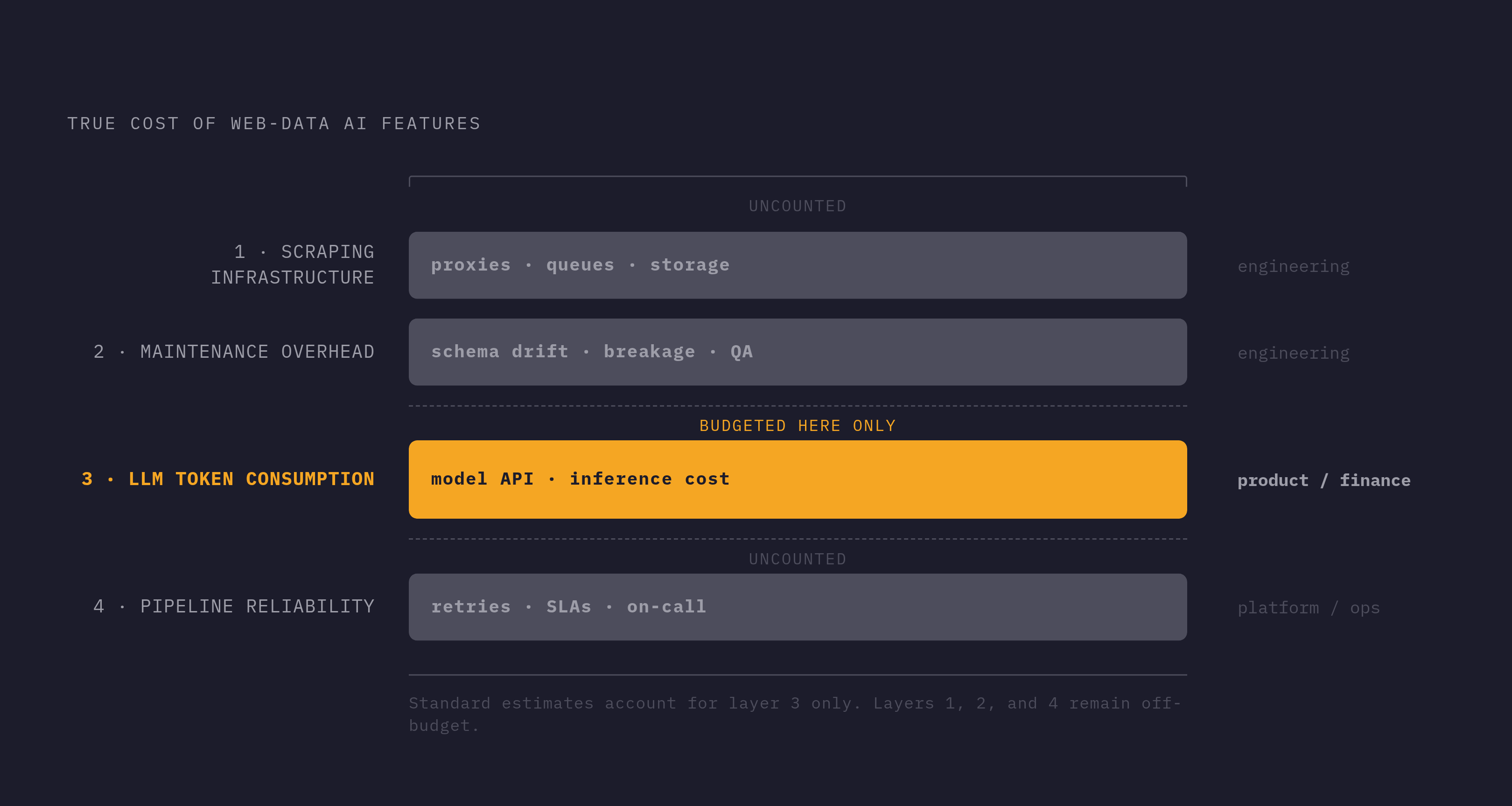
Four layers make up the real cost of a web-data-dependent AI feature: scraping infrastructure, maintenance overhead, LLM token consumption, and pipeline reliability. Each one hides for its own reason, so if you go back and fix a single assumption, you almost never catch the whole problem.
Scraping infrastructure gets priced by a vendor's sticker price or guessed at as a minor server expense. Either way, teams end up looking at a small API line item or badly lowballing what a self-hosted setup actually takes to run, and the true number appears only once the system hits production traffic. A request against a Cloudflare-protected, JavaScript-heavy page costs an order of magnitude more than a request against a static HTML page, but most estimates price every page the same.
Maintenance overhead never appears on an invoice. It lives in labor hours, and those hours get charged to some other project or never logged as a cost in the first place. A selector-based scraper breaks the moment a site changes its DOM structure, and it breaks silently: the pipeline keeps running, the output goes empty or wrong, and nobody notices until someone checks. That failure becomes unplanned engineering time that lands in a sprint retrospective instead of an infrastructure budget.
LLM token consumption gets estimated against clean, trimmed content, but the bill arrives based on whatever raw content the scraper actually sends. The delta between what the model needs and what it receives is the hidden multiplier. A raw page handed to a model can run to tens of thousands of tokens to extract maybe a few thousand tokens of content anyone actually wants, so the team pays several times more than the task required.
Pipeline reliability, the cost of retries, fallbacks, and monitoring when something breaks, rarely gets estimated at all, since putting a number on it means assuming a failure rate before the system has even run once.
The next three sections work through the first three layers in order, pricing each one concretely, so a team can build an estimate before committing engineering time to the build.
Layer 1: What scraping infrastructure costs at production volume
Scraping infrastructure cost tracks the complexity of the pages being hit, not the raw count of requests, and most estimates get the mix of page types wrong before they get anything else wrong.
The web splits into rough tiers of difficulty. Most pages are simple HTTP: a standard GET request pulls the full content, costs a fraction of a cent, and needs no special setup. A smaller but still meaningful share need JavaScript rendering through a headless browser tool like Playwright or Puppeteer, and that costs roughly 25 times more per request than a plain HTML fetch. A smaller slice still sit behind serious anti-bot defenses and cost more again. A workload where most targets are simple but a quarter of them need JS rendering runs on a completely different cost curve than one where the estimate assumed every page behaves the same way.
If you build scraping infrastructure in-house, you build four layers, not one script. There's a request layer handling TLS fingerprinting, headers, and cookies properly. There's a proxy layer managing pools, rotation, health checks, and failover. There's a browser layer running headless Chrome or Playwright instances for JavaScript-heavy pages, with memory management, crash recovery, and stealth patches to avoid detection. And there's an anti-bot layer, and it needs constant updates as detection systems change.
At high request volume, running that whole stack in-house typically costs more per month, in total, than paying a managed scraping API for the same traffic, and the gap grows wider as the target pages get harder to scrape. A managed API folds all four layers into a single per-request price, so the maintenance burden falls on the vendor instead. Pricing varies by provider and by complexity tier, with simple pages priced at the low end and anti-bot bypass pages priced at the high end of the range. Integrating one typically takes a few hours of engineering work, compared to the weeks it takes to stand up the in-house stack.
How a vendor prices its service matters as much as the raw per-request number. Credit-based pricing, where one credit nominally covers one page crawl, often hides multipliers for JavaScript rendering, anti-bot bypass, and retries. That makes cost hard to predict at scale: monitoring even a modest number of pages on an hourly schedule can burn through tens of thousands of credits a month. Flat per-page pricing with multipliers published up front is far easier to plug into a real estimate.
None of this touches what happens after the scraper is built and running. Keeping it running is its own cost, one that never appears on a vendor's invoice.
Layer 2: Maintenance overhead as the largest hidden labor cost
Maintenance overhead ends up being the biggest hidden cost in a web-data-dependent AI feature, because you count it in engineering hours instead of dollars per request. It appears nowhere on a vendor invoice and nowhere in an infrastructure budget line.
Two separate maintenance problems drive this cost. The first is selector decay. A site changes its HTML structure, and that silently breaks the CSS or XPath selectors a traditional scraper relies on. The pipeline doesn't crash, it just keeps running and returns empty or wrong data until some developer happens to notice. A scraper built on fixed selectors breaks immediately whenever a site renames a class or restructures its DOM, and it needs a developer to step in and fix it every single time that happens. On sites that get updated often, that's a frequent event.
The second problem is anti-bot evolution: detection systems keep evolving. Detection systems, Cloudflare Turnstile, HUMAN Security (the company formerly known as PerimeterX), DataDome, Akamai, push out updated payloads on an ongoing basis, so a bypass technique that worked last week can fail outright this week. These systems now cross-check TLS fingerprints, JavaScript environment probes, and behavioral signals together, so a bypass that was working can fail at any one of those layers independently of the others.
Both problems demand specialized labor, which is what makes the hours expensive. Managing proxies, understanding browser fingerprinting, and keeping anti-bot bypasses working isn't general backend engineering work, and the people who can do it are priced accordingly. A production self-hosted scraping system realistically ties up a meaningful chunk of a senior engineer's time every single month, indefinitely, just for deployment, monitoring, patching, and responding to incidents.
LLM-powered extraction changes this picture substantially but doesn't erase it. Because the model reads semantic content rather than DOM position, it shrugs off routine layout changes that would break a selector-based scraper outright, which cuts selector decay dramatically. It does not touch anti-bot maintenance, and it trades that savings for a new cost: tokens. The model adapts to a new DOM structure as long as the actual content is still there, but each page now costs something in inference and runs slower than a plain selector would. The right way to weigh that trade-off: across many different sites with inconsistent structure, the token cost of LLM extraction usually comes in well below what it would cost in engineering hours to build and maintain a custom selector for each one. But that math flips at high volume against a single, predictable site, where a well-maintained selector still wins.
An honest maintenance estimate has to answer a few specific questions: how many distinct domains are being targeted, how often each one changes its structure, how aggressively each one is protected against bots, and who on the team actually owns fixing it when it breaks. Without answers to those questions, the estimate defaults to assuming every target is stable and simple, an assumption true for some targets and false for others.
Once content leaves the scraper, a second cost meter starts running on the LLM side, and how clean that content is determines how fast that meter spins.
Layer 3: How scraping output quality drives LLM token cost
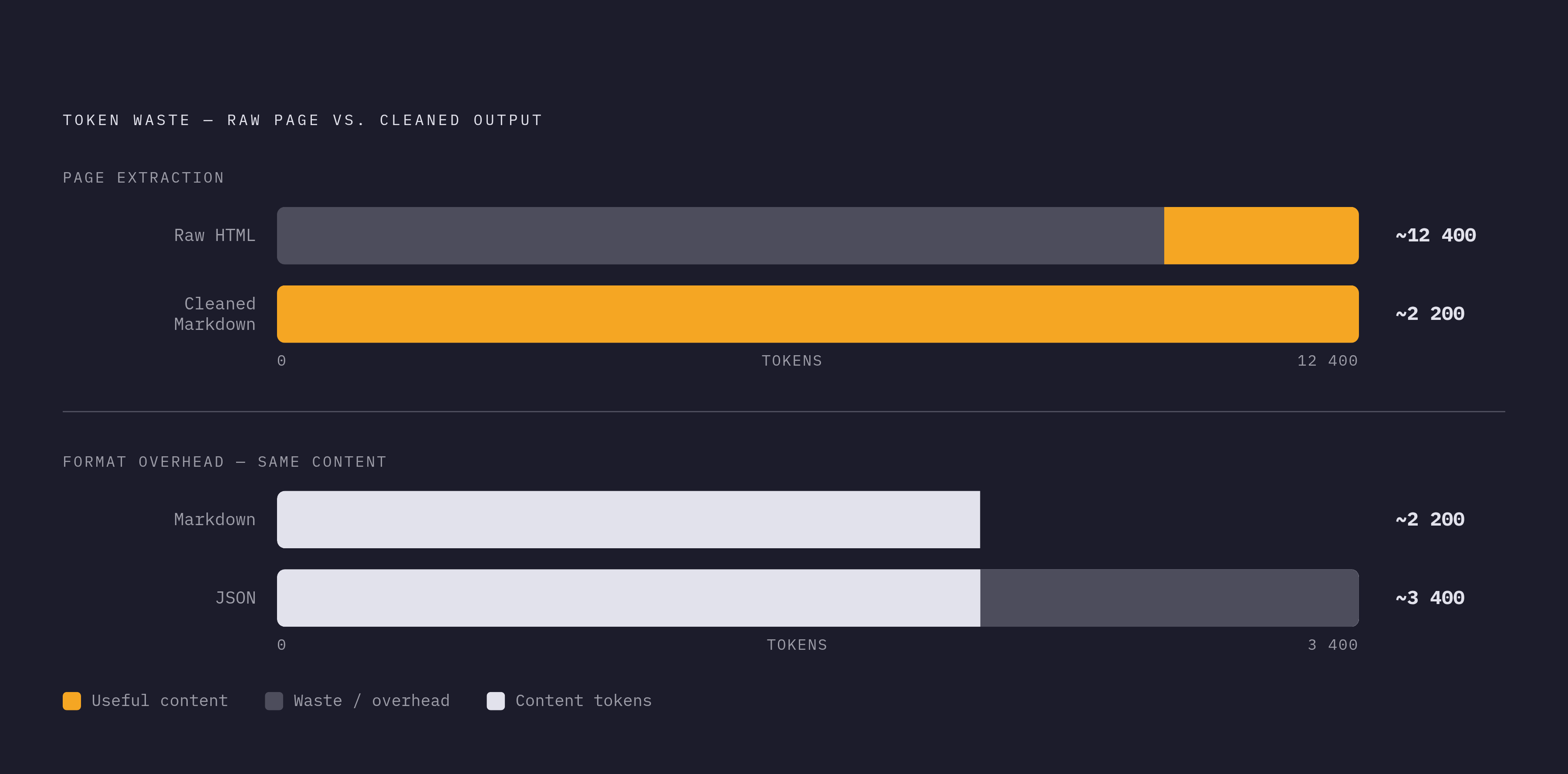
LLM token cost for a web-data-dependent feature depends less on which model gets picked and more on what the scraping layer hands that model. If a pipeline passes raw pages instead of cleaned content, it ends up paying several times the token cost it actually needs to.
The waste is concrete and repeatable. A raw page handed to an LLM can carry many times more tokens than the content the model actually needs, padded out with navigation menus, cookie banners, sidebar links, footer text, and language selectors, and the model reads and bills for every token of it. This isn't a rounding error. It compounds across every page in a pipeline indexing thousands of documents, and it adds up fast at that scale.
Output format adds another layer of waste on top of that. The same content returned as JSON costs meaningfully more in tokens than the same content returned as Markdown, since JSON carries syntactic overhead in its keys and brackets that Markdown simply doesn't have, and that difference adds up across a workflow making many calls. If you switch a scraping pipeline to return Markdown instead of raw HTML or JSON, that's one of the cheapest, highest-return fixes available. It needs no change to the model at all, just a pipeline change: adding an HTML-to-Markdown conversion step and adjusting how content gets chunked.
In a retrieval-augmented generation (RAG) pipeline, the generation step is where most of the per-query cost sits. Embedding, vector retrieval, and re-ranking all cost something, but LLM generation is the single largest piece of that bill, which puts the cleanliness and compression of the retrieved content in direct control of total query cost. A RAG system built on poorly cleaned web content pays that inflated cost on every single query it runs, not just once at indexing time.
Agentic pipelines add a variable that's harder to pin down: grounding calls the model triggers on its own. When an agent is set up to ground its answers by querying the live web, how many grounding calls it makes depends on how the model behaves on a given prompt, something the developer doesn't directly control. That attaches a variable cost to a part of the system the team doesn't fully govern. Estimating per-query cost for an agentic pipeline is inherently a probability exercise: the estimate needs an assumed grounding call rate going in, not a fixed one.
The cleanest way to control this cost is schema-driven extraction: defining a JSON schema up front and having the pipeline return only those fields, so nothing irrelevant ever gets passed downstream to the model. A structured extraction endpoint that accepts a schema and returns only the fields defined in it turns the token cost of every downstream LLM call into a direct function of how well that schema is designed. Get the schema right, and the LLM layer stops paying for the scraping layer's mess. That's the real lesson across all three layers: the cost of a web-data-dependent AI feature is set long before the first LLM call ever runs.
Sources
- Web Scraping for AI in 2026: What Works, What's Broken, and What It Actually Costs | by Yash Dubey | Medium
- How Much Does Web Scraping Cost? Complete 2026 Pricing Guide
- AI Agents for Web Scraping: Build LLM-Powered Data Pipelines (2026)
- The Future of Web Scraping in 2026: AI, Anti-Bot, and What Comes Next