Shipping a RAG-Powered Feature in a Weekend Using a Managed Crawl API
Managed crawl APIs let teams build RAG features fast by eliminating scraper complexity.
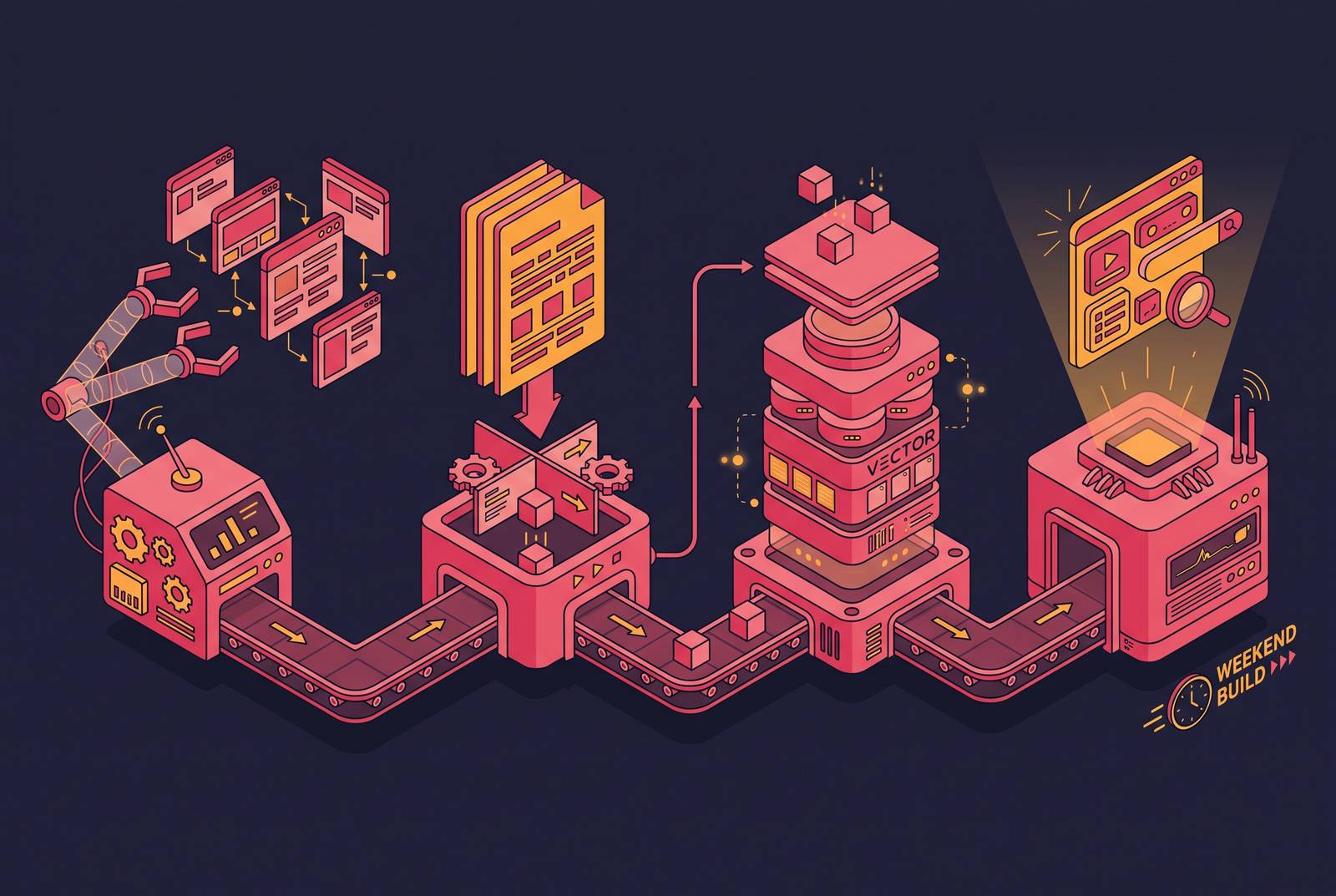
Shipping a RAG feature in a weekend is possible now for one reason: the crawl layer got boring. Grabbing clean web content used to eat most of a project's time. Now a single API call returns ready-to-use text, which frees up the actual weekend for retrieval logic, chunking decisions, and the product details that make a feature feel finished. If a team is still writing its own scraper in 2026, that's the wrong place to spend a weekend, and probably the wrong place to spend a quarter.
RAG, or retrieval-augmented generation, works by grounding a model's answer in evidence pulled at the moment someone asks a question, rather than relying only on what the model memorized during training. The core promise, as described in research on RAG published in Business & Information Systems Engineering, is that the model isn't guessing from frozen knowledge, it's checking a source first. Grounded retrieval keeps summarization tasks under a 2% hallucination rate. Open-ended generation without grounding runs 15 to 25%. That gap is the entire argument for RAG in one comparison.
None of that promise shows up automatically, though. Most teams that try to build a RAG feature quickly find out the retrieval logic isn't the hard part. Getting clean content into a vector store is. A scraper without help returns raw HTML, stuffed with nav bars, script tags, and layout junk that has to get stripped out before any chunking can even start. What an LLM pipeline actually wants is Markdown or plain structured text, not a web page, and building that conversion from scratch means solving anti-bot detection, JavaScript rendering, rotating proxies, and retry logic, none of which touches retrieval at all. It just eats the weekend.
Anyone who spends Saturday debugging a headless browser instead of tuning a retriever has already lost the weekend, no matter how the demo looks on Sunday night. A weekend build only becomes realistic once the crawl layer gets handed off entirely.
What a managed crawl API actually collapses into one step
Without a managed API, a team assembling a crawl pipeline from scratch ends up stitching together five or six separate pieces, including a headless browser for pages that lean on client-side scripting, a proxy or anti-bot service so requests don't get blocked, an HTML-to-Markdown converter, a scheduler for repeat crawls, and retry logic on top of all of it. Each piece is its own dependency, its own point of failure, its own maintenance job. That's not a stack. That's a liability with five owners.
A managed crawl API turns that into one REST call. Hit the endpoint, get back Markdown that's already clean, with JavaScript already rendered and bot detection already handled. Point it at a sitemap instead of a single URL, and it crawls the whole site in one pass.
Four things decide whether a given API earns its place in a RAG pipeline. Walk away from anything missing more than one:
- Clean Markdown output, so tokens aren't wasted on layout noise
- Full-site crawling from a single URL or a sitemap, not just one-page fetches
- JSON schema extraction, where the team defines a target structure and gets back data that matches it
- Anti-bot and proxy handling that works without manual configuration
Schema extraction is the one people underrate, and it's the one worth taking seriously before anything else on that list. Research published on arXiv in October 2025 under the name PARSE found that schema-optimized extraction improved accuracy by up to 64.7% on the SWDE benchmark and cut extraction errors by 92% within the first retry. Most of that gap has nothing to do with the model. It comes from sloppy schema design upstream, which is exactly the failure a managed API is built to close.
That doesn't erase the build-versus-buy tradeoff, and it's worth being blunt about where each side wins. A managed API removes infrastructure work and shrinks the number of moving parts a team owns. Self-hosted libraries hand back more control over processing and cost less per request once volume climbs. But the weekend build only makes sense if the bottleneck is setup time. If the bottleneck is unit economics at scale, that's a different calculation entirely, and no amount of clever chunking fixes a cost problem.
The managed crawl API options a team is choosing between
The market has split into two camps: managed API-first services, and self-hosted open-source tools. For a weekend build, the question that matters is time-to-first-working-call, meaning how much a given tool handles before a developer has to configure anything. Pick for that, not for the longest feature list. That single filter rules out most of the market before comparison even starts.
One option worth naming is backed by Y Combinator, with Zapier and Replit among its customers. It bundles anti-bot handling and an MCP server into the same product, so a team doesn't need to stitch together a scraper, a proxy service, and a data vendor separately. It fits best when the goal is one API covering the full web-to-LLM stack, start to finish.
A different option leans on the simplest possible interface: prefix any URL with a reader endpoint and get Markdown back. It runs on headless Chrome, with an optional 1.5-billion-parameter model handling the HTML-to-Markdown conversion. That's genuinely fast for prototyping against a handful of known URLs. But it wasn't built for crawling a whole site or pulling structured data against a schema, and stretching it to do either just wastes the weekend a different way.
On the self-hosted side sits a Python crawler built specifically for AI pipelines: Markdown output, support for vision models on page screenshots, async crawling for concurrency, running locally under an Apache 2.0 license with no per-request cost. Self-hosting hands the anti-bot and proxy problem straight back to the team. Most groups that go this route end up pairing it with some kind of managed fetch layer for the sites that actively resist scraping, which quietly reintroduces the exact complexity they were trying to avoid. This is a reasonable choice for a team with time to spend on configuration and a real cost constraint, but it's not the fastest way to ship by Sunday night. Anyone picking it for a weekend build is picking it for the wrong weekend.
A fourth category, AI-native search APIs that use semantic understanding rather than fixed URLs, is worth watching rather than reaching for on day one. This space picked up urgency after Microsoft retired its Bing Search APIs in August 2025, pushing teams that never had to think about search infrastructure to suddenly go shop for it.
How the RAG pipeline fits together once the crawl layer is handled
Handing off the crawl work doesn't remove the rest of the pipeline. Four decisions still need real thought, including chunking strategy (fixed-size, semantic, or structure-following, a choice that swings retrieval recall hard), the embedding and vector store setup, query encoding and retrieval logic, and reranking before anything reaches the generator.
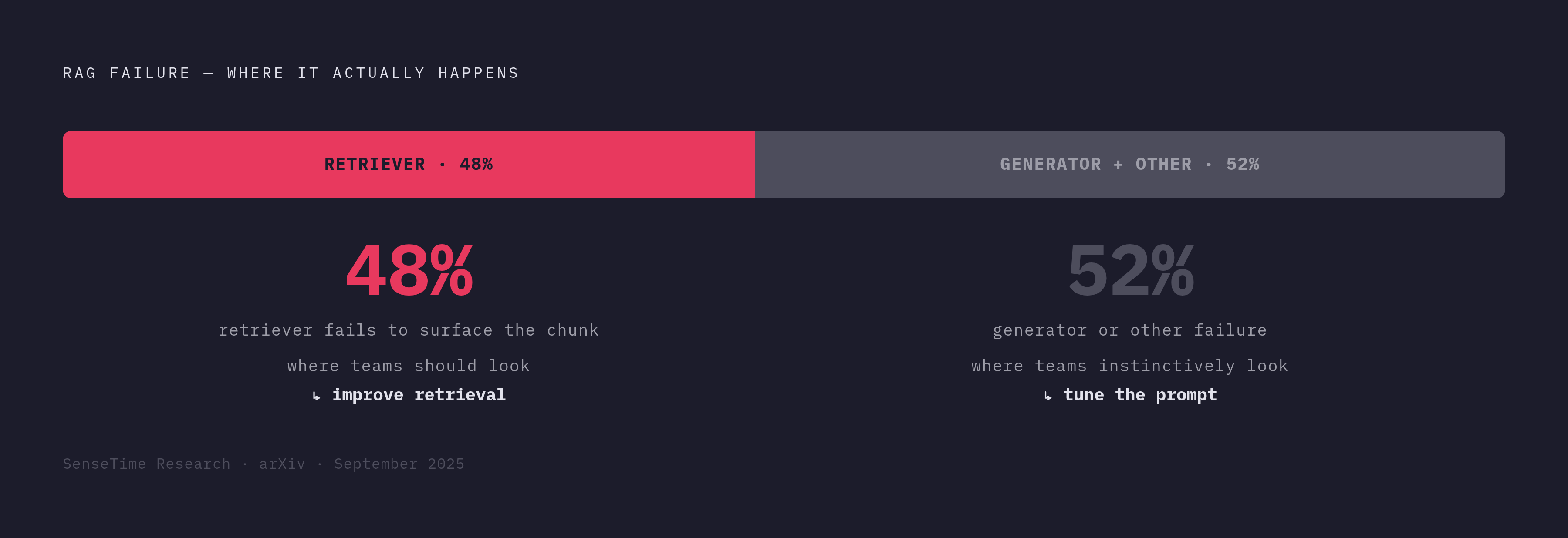
Retrieval, not generation, is where most RAG systems actually break, and this is the part teams get backwards constantly. A September 2025 arXiv paper out of SenseTime Research, on a project called "fishing for answers," found that 48% of traditional RAG failures come down to the retriever failing to surface the right chunk in its top results, not the generator producing a bad answer from good evidence. So when a demo gives a wrong answer, the instinct to go tune the prompt is usually pointed at the wrong half of the system.
Multi-step pipelines make this worse fast. Compounding steps means errors multiply, and end-to-end accuracy degrades quickly across a chain. For a weekend build, the fix isn't cleverness, it's restraint: keep the pipeline shallow.
The TREC 2025 RAG Track, run by researchers including a team from the University of Waterloo and published on arXiv in March 2026, introduced long, multi-sentence narrative queries meant to mirror the kind of reasoning-heavy search people actually want, with attribution and evidence coverage now measured as standard, not bolted on after. That's the direction retrieval design is heading, and none of that ambition belongs in a first weekend. Sequential single-pass retrieval, with a fixed token budget for what gets handed to the generator, is the right starting point. Iterative, agentic retrieval is the upgrade to reach for once the baseline actually ships and works, not before.
A concrete weekend build sequence using a managed crawl API
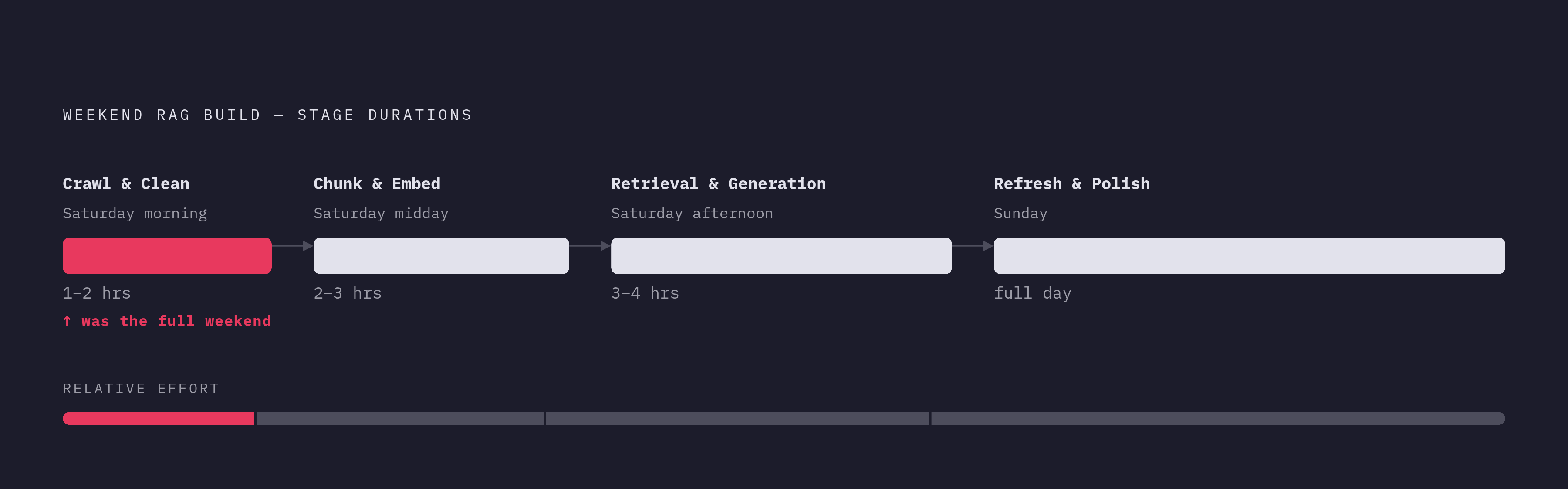
Assume a team of one or two developers, existing access to an LLM API, and a defined set of URLs or a domain to ground the feature on. Here's how the weekend actually breaks down.
Saturday morning, crawl and clean (1 to 2 hours). No browser setup. No proxy configuration. No writing markup-cleaning code by hand. This is the time a managed API buys back, and it's the biggest chunk of savings in the whole build. If the feature needs structured data instead of free text, define a JSON schema, pass it to the extraction endpoint, and get back JSON that matches it, no CSS selectors, no custom parser. What comes out the other end is a corpus of clean Markdown, ready for chunking.
Saturday midday, chunking and embedding (2 to 3 hours). A structure-aware chunking method, splitting on Markdown headings, is faster to build than semantic chunking and maps directly onto the Markdown the crawl API already returned. Embed the chunks, load them into a vector store, and attach source URL metadata to each one. That metadata is mandatory, full stop. It's what makes attribution possible later, and skipping it now means rebuilding the pipeline later to add it back.
Saturday afternoon, retrieval and generation scaffold (3 to 4 hours). Wire the query encoder to the vector store, pull the top-k chunks, feed them into the generator prompt. Run a smoke test on known queries: does the feature return an answer that's actually grounded and traceable back to a source, or does it just sound confident?
Sunday, refresh logic and polish (full day). Because the crawl step is a single API call, scheduling a recrawl on a cron job or a webhook is a one-line addition, and it's what keeps the feature from going stale right after launch. Handle the edge cases: what happens when no relevant chunk turns up, what the fallback behavior looks like, where the confidence threshold sits. Surface source URLs next to generated answers, both for user trust and to make any hallucination easy to catch. Benchmark end-to-end response time, and if it's too slow, cut the number of chunks passed to the generator before reaching for anything more complicated like iterative retrieval.
The goal for a first ship is narrow: one use case, one domain, one retrieval path, working end to end. Not a general system, and not an impressive one. Without a managed crawl API, this entire weekend gets consumed by headless browser setup, anti-bot debugging, and rate-limit handling, none of which is retrieval logic, and none of which is the feature anyone actually asked for.
What freshness means for a RAG feature after it ships
A RAG corpus indexed once and left alone starts going stale immediately, and this is where most shipped features quietly rot. Knowledge cutoff limitations cause outdated or fabricated answers in more than 30% of queries about current topics, according to hallucination data compiled by sqmagazine.co.uk. That's not a rounding error for a feature that's supposed to be trustworthy. That's a coin flip on anything time-sensitive.
Grounding answers in live web content fixes this at the source rather than patching around it. Data from parallel.ai shows web-grounded models gaining 25 to 40 percentage points in factual accuracy on benchmarks like SimpleQA and FRAMES, holding up across different query types.
With a managed API, keeping the corpus fresh means setting up a cron job or an event trigger that re-runs the same crawl call from Saturday morning. No new infrastructure, no scraper to patch. Compare that to a self-built crawler: one layout change on the target site, one new anti-bot rule, one CDN switch, and the scraper breaks. Someone has to fix it by hand before the index updates again, and that someone is usually the person who least wants to spend a Tuesday afternoon on it.
How fresh the feature stays depends on how often it recrawls. News, product catalogs, or documentation that ships alongside code needs daily recrawls to stay current. Slower-moving knowledge bases can get away with weekly. That's a call the team makes based on how fast the underlying content actually changes, not a default left at whatever the API ships with.
The direction the TREC 2025 RAG Track is pointing, toward long narrative queries and answers that carry their own evidence trail, is where this feature eventually needs to go: iterative retrieval, with provenance tracked at every step. Getting there doesn't mean rebuilding the data layer from zero. A managed crawl API is what keeps that upgrade path open, since the crawl call handling Saturday's build is the same one that scales into whatever comes after it.
Sources
- Overview of the TREC 2025 Retrieval Augmented Generation (RAG) Track
- Fishing for Answers: Exploring One-shot vs. Iterative Retrieval Strategies for Retrieval Augmented Generation
- Retrieval-Augmented Generation (RAG) | Business & Information Systems Engineering | Springer Nature Link
- arxiv.org
- parallel.ai