Keeping User-Facing AI Summaries Fresh When Source Content Changes
Stale summaries fail when source content changes, not when AI models hallucinate.

A summary tells a user a product costs a certain amount, and the price has since gone up. The model did not hallucinate, it did not misread anything, and the sentence it produced was accurate the day it was generated. The source page changed after that, and nothing in the pipeline noticed.
That is the actual mechanism behind stale AI summaries: not a reasoning failure, but a grounding failure that happens downstream of generation. Grounding anchors a model's output to retrieved evidence at a specific moment. No chunk, no claim. That constraint only works if the chunk still matches the world. Whatever the source said at crawl time gets locked into the index, and the summary built on it inherits that lock.
Two failure modes compound this. Coverage gaps happen when a page didn't exist at index time, so retrieval can't find it no matter how relevant it is. Drift happens when a page did exist and got indexed, but the page has since changed while the embeddings still point at the old text. There is always a gap between when a source changes and when the index catches up.
What makes this dangerous is that the failure is invisible at the point of use. A stale summary reads exactly like a fresh one. No flag, visual cue, or hedge in the model's language signals that the grounding underneath it might be six weeks out of date. Confidence in the output has nothing to do with the currency of the source it was built from.
What source drift looks like across different content types
Drift doesn't move at one speed. A single re-crawl schedule applied across an entire corpus is wrong for most of that corpus, because different content types change at wildly different rates and with wildly different consequences when they do.
Some content is volatile and the cost of citing a stale version is immediate. A summary grounded on last week's pricing page quotes a number the vendor has already revised. A summary built on last month's security advisory might tell a user a vulnerability is unpatched when it's been fixed.
Other content moves slower but the eventual drift still matters. A summary built on a months-old product page can describe a feature set the company no longer offers, and because the change was infrequent, nobody thought to check for it.
Time-based schedules also miss three patterns that aren't about elapsed time. A cited source can return a 404. And a known-volatile entity, a company, a product, a regulation, can appear in otherwise stable content and change state on its own timeline, independent of when the page around it was last touched.
Why scheduled re-crawls alone cannot keep summaries current
The instinct to fix staleness by crawling more often is understandable, and it's also structurally incomplete. Re-crawling everything on a tighter interval burns compute re-embedding and re-indexing pages that never changed, while still leaving gaps for anything that changes between scheduled runs.
Every scheduled crawl sets a ceiling on how fresh a summary can possibly be: the worst-case staleness is the length of the crawl interval, full stop. There's no interval short of continuous monitoring that eliminates the gap, and continuous monitoring of every URL at full crawl depth is not economically sane for most corpora.
Detecting when a specific source has changed enough to invalidate a specific summary matters more than how often everything gets re-crawled. That's a detection problem, not a cadence problem, and it points toward a different kind of architecture.
The architecture of a drift-detection pipeline: monitor, diff, re-ground
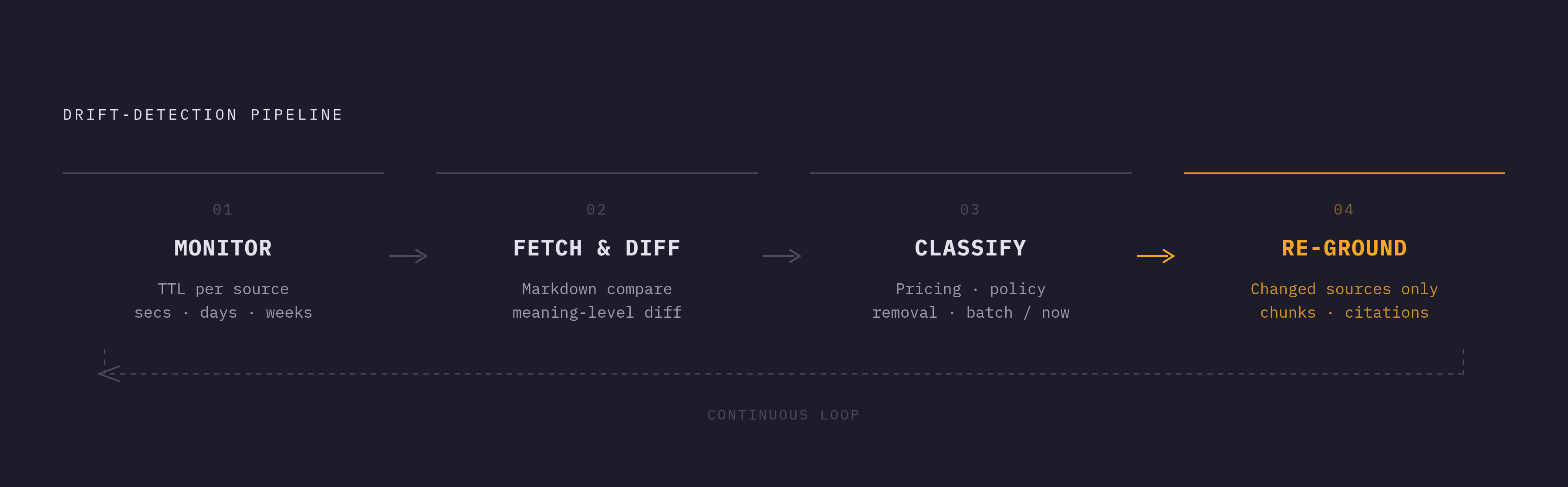
The fix for source drift is a loop, not a faster clock. A pipeline that monitors source URLs for meaningful change, diffs new fetches against what's stored, and re-grounds a summary only when a substantive change is detected solves the problem that scheduled re-crawling can't: it ties freshness to actual change, not to elapsed time.
The loop runs in four stages.
Monitor comes first. Instead of a global crawl cadence, each source URL gets a freshness TTL calibrated to its content type: seconds for a price feed, days for a product spec page, weeks for a reference document. The TTL marks how long a cached fetch stays trustworthy before a re-fetch gets triggered, and it's the central engineering lever in this kind of pipeline because it lets volatile content get checked constantly while stable content gets left alone. TTL expiry isn't the only trigger, either. Event triggers catch what schedules miss: a 404 response, a correction notice published on the source, or a known-volatile entity changing state inside otherwise unchanged content.
Fetch and diff comes next. When a TTL expires or an event trigger fires, the pipeline retrieves the current page as clean content and compares it against the stored version. Fetching to clean Markdown first, stripping navigation, ads, and boilerplate, prevents false positives: a raw HTML diff flags every ad rotation or nav tweak a site makes, and those false positives drown out the diffs that actually matter. The comparison needs to work at the level of meaning, not characters. A character-level diff flags everything. A semantic or section-level diff flags the paragraph where the price changed and ignores the layout edit next to it.
Classify the change third. Some detected differences matter more than others. A changed price, a revised policy, a product that got pulled, these invalidate any summary that cites them. A new paragraph added to an unrelated section of the same page probably doesn't touch the summary. Automated classification can sort a detected change into categories like pricing update, policy change, or content removal, and route each category differently: some trigger an immediate re-ground, others get batched for a less urgent pass.
Re-ground last. Only the summaries tied to a materially changed source get regenerated, which is the efficiency gain that makes this whole architecture viable at any scale beyond a handful of pages. Re-grounding follows the same path as the original grounding step: fetch the clean content, extract the relevant chunks through a defined schema, and feed those chunks to the model with citation anchors intact.
The contrast with "re-crawl everything on a schedule" is the whole point of the design. Re-crawling spends resources uniformly across a corpus regardless of what changed. Monitor, diff, re-ground spends resources where change actually happened, and leaves everything else untouched.
Fetching clean content at the right moment: the role of live-fetch versus cached re-use
Running this loop doesn't mean live-fetching every source on every check. The right default is conditional re-fetch, governed by TTL expiry and event triggers, with cached clean content serving every request in between.
The trade-off between live fetch and cached reuse is straightforward. Most production systems land in a hybrid middle: fetch live when a query is time-sensitive, reuse cached chunks under a freshness TTL everywhere else.
Applied to a drift-detection pipeline, that hybrid pattern looks like this: cache the clean fetched content alongside a TTL timestamp. For stable content, this turns monitoring into a lightweight polling check that rarely results in an actual fetch. For volatile content, it means a prompt re-fetch the moment the TTL window closes.
Fetching live sources reliably carries its own friction, separate from the question of when to fetch. Geo-gating, rate limits, and anti-bot protections mean the same URL can return different content, or fail outright, depending on how and from where the fetch is made. Reliable fetch infrastructure is what keeps the diff step in the previous section honest.
Routing queries to fresh content: freshness-aware retrieval at inference time
A drift-detection pipeline running cleanly in the background doesn't finish the job on its own.
Not every query carries the same freshness requirement. Scoring freshness sensitivity as the first step in a hybrid retrieval architecture means the system decides whether freshness matters at all before it decides how to satisfy the query, and that classifier can start simple, a lookup table of topics known to be freshness-sensitive, before evolving into a model that scores each incoming query on its own.
When a live fetch isn't triggered, freshness signals still shape which cached version gets served. The pipeline should surface the most recently verified clean chunk for a source, not just the most recently embedded one. A chunk that was checked against its source URL after the last detected change carries more weight than a chunk that happens to have a newer embedding timestamp but was never verified against anything that moved.
A final layer of protection sits at generation time itself. Amazon's Bedrock Guardrails ships a contextual grounding check that scores a model's response for grounding and relevance against a supplied source, with a configurable threshold for rejecting responses that fall short. That check catches a specific failure the rest of this pipeline can't: the retrieved chunk is current, but the model's sentence still drifts from what the chunk actually says. It's a control layered on top of retrieval, not a replacement for keeping the source content itself fresh.
Where agentic pipelines change the freshness problem
Agentic systems break the assumption that freshness can be handled entirely as a background job. An agent reasoning through a multi-step task needs the ability to request a live fetch of a specific URL mid-task, the moment it suspects its cached knowledge might no longer hold.
The sequence looks like this inside the agent's own tool-use loop: the agent encounters a source URL relevant to the task, checks that URL's TTL, finds the cached version has expired, and requests a fresh fetch before it grounds its next output in that content. That check happens inline, as part of reasoning, rather than on a schedule set by some external job that runs independently of what the agent is actually doing at that moment. This is the same detection loop described earlier, monitor, diff, re-ground, just relocated from a background process into a tool the agent calls on its own initiative.
Implementing the pipeline without rebuilding data infrastructure from scratch
Building the full fetch-detect-re-ground loop on custom infrastructure tends to demand far more maintenance than teams expect. The parts that actually differentiate a product are worth owning directly. The parts that don't differentiate the product get delegated to infrastructure built for exactly this.
Three things belong to the team building the product. The TTL policy and the thresholds for what counts as a significant change encode real domain knowledge: which content types matter to this specific application, and how much drift in each one is enough to justify a re-ground. The query freshness classifier is product logic, reflecting what this application's users actually ask and how time-sensitive those questions tend to be. The re-grounding prompt and the output schema define what a summary should contain, which is a decision tied to the product, not to the mechanics of fetching.
Everything else is infrastructure that doesn't need to be built from scratch. Fetching arbitrary URLs reliably at scale, handling pages rendered dynamically on the client side, getting past bot defenses, and converting raw HTML into clean, LLM-ready Markdown are all undifferentiated problems that every team solving this faces identically. A do-it-yourself version of this stack typically runs four separate steps, a search API, a headless browser, an HTML parser, and a chunking layer, and each one adds its own latency, cost, and ongoing maintenance. Collapsing those four steps into a single API call is the right abstraction for most teams, the same way schema-driven structured extraction, defining a JSON schema once and letting an API return exactly those fields, beats maintaining a set of CSS selectors that breaks the next time a site redesigns its layout.
The practical test for whether a team has drawn this line correctly: the components it owns should take days to wire together, not weeks. The bottleneck should be the product decisions, TTL policy, schema design, not a fight with fetch reliability or HTML cleanup.
Measuring whether the pipeline is working: signals that freshness is holding
A drift-detection pipeline with no observability built in reproduces the exact problem it was built to solve, just one layer removed. Summaries can still be stale, and now there's no signal telling anyone that the detection loop missed something.
The core metric is agreement between source and summary at the moment a re-ground fires: when a re-ground runs, does the new summary actually differ from the old one in a way that matters? A high rate of re-grounds producing no meaningful change points to TTL thresholds set too aggressively, spending resources reacting to changes that never touch the output. A low re-ground rate paired with users reporting inaccurate summaries points the other way: TTLs are too loose, or event triggers aren't firing when they should.
Source health checks catch failures that TTL expiry and semantic diffing can't see on their own. A URL returning a 404 is a detection event in its own right, not a fetch failure to quietly retry and move past. A source that returns content with a restructured layout can pass its TTL check cleanly while still failing structured extraction. The extraction step itself then doubles as a signal that something about the source has changed in a way worth investigating.
None of these thresholds are fixed once and left alone. The calibration is iterative: observed re-ground rates and grounding scores feed back into tighter or looser per-topic TTLs over time, as the pipeline learns the real change rate of each source it watches. Run that loop long enough, with the right signals feeding back into it: freshness turns from a worry teams carry around into something they can actually measure.