Replacing a Fragmented Vendor Stack With a Single Web Data API
Consolidating five vendors into one API cuts maintenance overhead and prevents cascading failures.
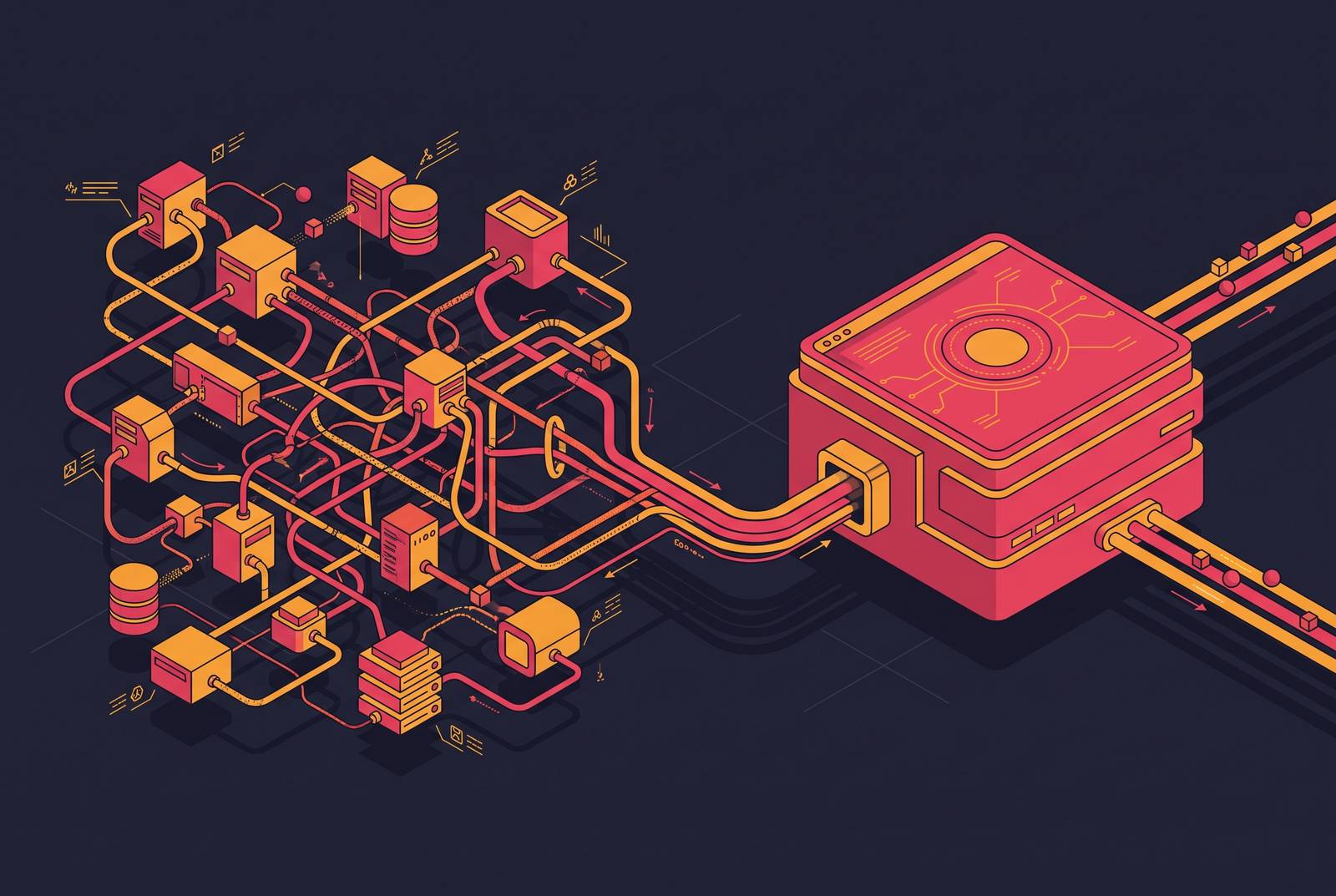
A team usually notices the problem on the night a dashboard breaks and nobody can say which vendor caused it. That moment, five tabs open, five support queues, no clear owner, is the tell that a web data stack has stopped being infrastructure and started being a second product the team has to run. This piece lays out how that happens, why it gets worse rather than steadier over time, and what changes when a team replaces the pile of point solutions with one well-built API.
A typical AI team's web data stack growing into a liability
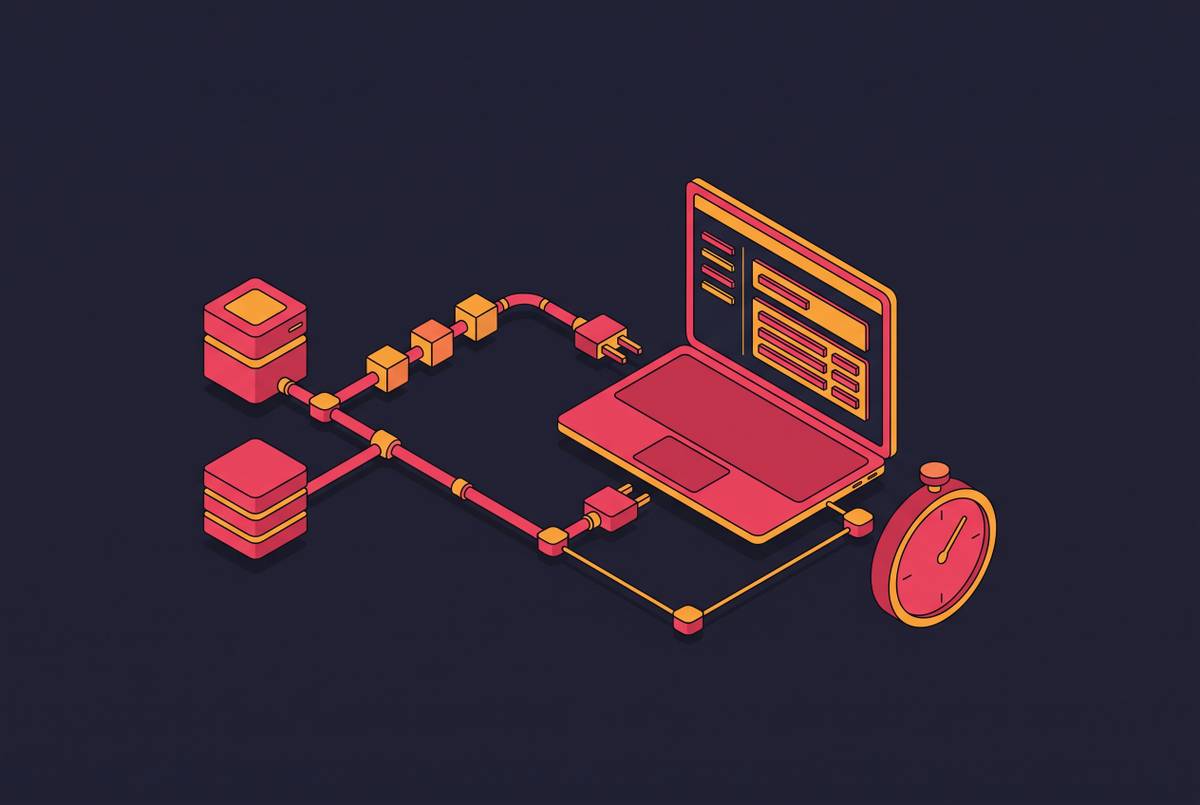
It happens one gap at a time. A team needs proxies, so they pick a proxy vendor. The raw HTML that results is too messy for a language model to read well, so a Markdown converter gets bolted on. Then they need the output in a specific shape, so they add a structured extraction tool. Then someone asks to be notified when a competitor's pricing page changes, so a fifth vendor goes in for change detection. Each addition made sense on its own. Looked at together, they form a pipeline nobody designed on purpose.
The upkeep on that pipeline is worse than it sounds, because it was never evenly weighted toward the build. In a typical scraping setup, only about 20% of the effort goes into building the thing, and 80% goes into keeping it running, chasing broken selectors, rotating credentials, patching timeouts. That 80% tax applies separately to the proxy layer, the rendering layer, the parsing layer, the extraction layer, and the monitoring layer, and it grows with every vendor added to the chain.
Anti-bot defense has made the whole setup heavier to maintain. Cloudflare Turnstile, HUMAN Security (the company formerly known as PerimeterX), and DataDome now check TLS fingerprints, probe the JavaScript environment a browser reports, and watch behavior patterns over time. Rotating IP addresses used to be most of the battle. Now a team also has to keep headless browsers patched to look like real ones and manage pools of residential IPs just to get a page to load at all. None of that was true a few years ago in the same way, and none of it shows signs of easing. A team that built its stack for yesterday's defenses is already behind the defenses running today.
Compounding failure, not additive cost
The real danger in a multi-vendor stack is not more parts but parts that fail together instead of apart, with each seam between tools a point where one small breakage spreads to everything downstream of it.
Take the way traditional scrapers read a page. Most still rely on CSS selectors, little rules that say "the price is in this class, the title is in that one." A UI team renames a class, and the selector breaks silently. The scraper doesn't crash, it just starts pulling the wrong thing, maybe grabbing navigation links instead of actual content. That bad data moves downstream and gets treated as real knowledge by whatever model consumes it. A fetch-layer glitch turns into a model-quality problem by the time anyone notices.
Anti-bot defenses sit upstream of that entire chain, which makes them the most expensive failures to miss. If a page never loads because a bot check blocked it, no extraction tool downstream can do anything, no matter how good it is. Fetch success is the floor that every later stage depends on. And that floor is uneven across the web: every tool in one benchmark except one scored zero on Akamai-protected retail pages. A team that selected a vendor based on Cloudflare performance may have a blind spot that only becomes visible in production.
Mixing vendors adds a second kind of seam. Some return clean Markdown ready for a model to read. Others hand back raw HTML that still needs a separate parsing step before anything useful comes out. A team running multiple vendors ends up writing glue code just to make the outputs look like they came from the same place, and that glue code is itself a thing that can break.
When something does go wrong in a five-vendor pipeline, finding out why means checking five separate dashboards, five rate-limit policies, and five output formats before anyone can even confirm where the failure started. The time it takes to fix a problem scales with how many vendors are stacked on top of each other, not with how serious the problem actually is.
The "garbage in, garbage out" cost when stale or malformed data reaches the model
All of this eventually lands on the model, and it's visible there well before anyone traces it back to a broken selector or a missed bot check. By April 2026, the industry had started moving away from brittle, rule-based scraping toward smarter extraction methods built specifically to fix the garbage-in-garbage-out failures occurring across retrieval systems.
Language models carry a lot of knowledge, but that knowledge is frozen at whatever point their training ended. It can't be checked against the present, and refreshing it costs real money and real time. Any system that pulls in live web data to fill that gap only works if the data coming in is actually clean. If it isn't, the system just inherits the same staleness it was built to fix, dressed up as fresh information.
The standard fix used to be a nightly batch job: re-index everything, every night, whether it changed or not. That approach is giving way to streaming re-indexing, where only the documents that actually changed get re-embedded, as soon as they change. A stack that can't tell, structurally, when something on a page has changed has no way to support that kind of architecture. It's stuck re-processing everything on a timer instead of reacting to what actually moved.
LinkedIn's customer support system is a working example of the alternative. Support knowledge there changes constantly and is proprietary, so answers come from retrieved, current content rather than from whatever the model happened to learn during training. Retrieval is exposed as a tool the model can call mid-reasoning rather than bolted on as a preprocessing step, so the system itself decides when to go look something up and how to phrase the lookup. That only works because the data feeding it is trustworthy enough to query on demand. A fragmented stack that can't guarantee clean, current data at the moment it's needed can't support that pattern. The gap between the two isn't a matter of degree.
What a well-designed single API collapses into one contract
A single, well-built web data API doesn't sit on top of the existing stack as one more layer to manage. It takes over the stages that stack was built to handle, fetching, rendering, parsing, and extracting, and puts them behind one versioned contract a developer can actually reason about.
Proxy rotation and IP management happen inside that contract, invisible to whoever is calling the API. Headless browser rendering is handled the same way, so a React or Next.js page that returns empty HTML on a plain fetch still comes back with real content. Anti-bot handling, including TLS fingerprint spoofing and behavior that mimics a real browsing session, is built into the same request path rather than requiring a separate tool and a separate contract to manage it. Output arrives as Markdown stripped of navigation, ads, and cookie banners, or as structured JSON that matches a schema the developer defines upfront, enforced through schema-driven prompts or function-calling rather than left to chance. Change detection comes through as a structured event rather than a screenshot someone has to eyeball.
The order of operations underneath it is what makes this more than a repackaging exercise. The right default pulls data from embedded JSON-LD first, since it's nearly free and close to perfectly accurate when it's present. Only when that fails does the system fall back to schema-driven extraction using a model, and raw parsing is the last resort, not the default. A single API can run that triage internally every time a request comes in, instead of leaving each team to rebuild that judgment call themselves. The recommended order for actually getting data off a page follows the same logic: check for an official API or an XHR JSON response first, then look for embedded JSON on the page, then reach for a browser agent only if JavaScript rendering or a login is genuinely required, and save model-based extraction for small cleanup jobs that need a human-reviewed pass. A single API that bakes in that hierarchy means a team never has to wire it together by hand, and never has to remember to.
MCP and the changing interface between AI agents and live web data
The shift toward single-contract APIs lines up with a bigger change in how AI agents talk to outside systems in the first place. An open standard for connecting models to external tools and data was released in late 2024. It has become the default way agents reach enterprise data, replacing what used to be a custom integration for every tool and every application that needed one. By mid-2026, almost every major data platform ships its own MCP server, which makes MCP about as close to a settled standard as the agent ecosystem has.
For web data specifically, MCP changes the shape of the work. The old pattern was "kick off a scraping job, then poll for results." Under MCP, an agent just asks for data when it needs it, mid-task, and gets it back inside the same reasoning loop it's already running, with no separate polling system for a team to build and babysit.
A related shift arrived from the browser side. On February 10, 2026, Google's Chrome team announced WebMCP, a browser API that lets websites expose structured tools to AI agents directly, and it began shipping as an early preview in Chrome 146 Canary. Instead of an agent parsing a page's DOM to figure out what it can do, a site using WebMCP can declare typed tools with explicit parameters the agent calls directly. Where it's adopted, a scraping task becomes a tool call instead of a page-fetch.
That direction matters for the consolidation argument specifically. A pile of five vendors has no way to present a single, coherent set of tools to an agent, because there are five separate surfaces with five separate behaviors. A single API with its own MCP server can offer one tool endpoint that covers fetching, rendering, extraction, and change detection all at once, which keeps the agent's reasoning loop simple instead of forcing it to juggle five different interfaces.
Brand data and change detection as the two use cases that expose the fragmented stack fastest
Two use cases make the cost of a fragmented stack obvious faster than almost anything else: brand intelligence and change detection. Both need structured, repeatable extraction from sources that change without warning, and both punish a stitched-together pipeline quickly.
Picture an agent that needs to pull a company's logo and its primary brand color the moment a user mentions that company, not from some database that was last updated six months ago. That's what brand intelligence as an API primitive looks like in practice. A capability built for this, sometimes called Unified Brand Retrieval, takes almost any identifier, a domain, a company name, a work email, a stock ticker, even a credit card descriptor, and turns it into a typed JSON record with a display-ready logo, a postal address, and social profiles attached. That replaces a research task a person used to do by hand or across several separate vendor calls, and it only works if the underlying data layer is reliable enough to answer the request in real time.
Change detection works the same way. Treating a detected change as a structured event that a system can store, route, or act on in JSON form is fundamentally different from treating it as a screenshot a person has to look at and judge for themselves. Teams that try to build this in-house tend to follow the same path: add a headless browser, then wait logic for content that loads asynchronously, then proxies, then retry logic, then snapshot storage, then a way to normalize the DOM, then text-region comparison, then a webhook to deliver the result. By the end of that list, the team is running a monitoring product it never meant to build.
Done well, a structured diff can feed directly into a RAG pipeline: a change event triggers re-embedding of just the document that changed, which is what actually makes streaming re-indexing possible. That only works if the change arrives as structured data in the first place, which a system can act on directly instead of a visual diff someone has to interpret.
The consolidation decision for an engineering team
None of this means one API handles every target on the web, and that objection deserves a straight answer rather than a dodge. No vendor has universal coverage, and some protected targets, Akamai-perimeter retail among them, remain genuinely hard for any tool to crack. The June 2026 benchmark put success rates for six different APIs somewhere between 42% and 75% across 24 test URLs, and Akamai-protected retail was a category where almost every tool failed outright. There's no single tool that solves the whole web, and pretending otherwise sets a team up for a bad surprise in production.
The case for consolidation is that one well-built API solves the 80% of requests that most teams have badly over-engineered, and the remaining 20% that genuinely need specialized handling should be isolated and treated as exceptions, rather than being allowed to drag the rest of the pipeline into the same complexity.
Judging a given API against that standard comes down to a handful of concrete questions. Does the API hand back LLM-ready Markdown or schema-validated JSON, or does it dump raw HTML and leave the parsing work to the team? Does it manage anti-bot rendering on its own, so a blocked fetch doesn't quietly corrupt everything built on top of it? Does it treat change detection as a structured event that a streaming re-indexing pipeline can actually use, without extra infrastructure bolted on afterward? Does it ship an MCP server, so it plugs into an agent's workflow without custom glue code holding the connection together? And does it hold up on compliance, which carries real weight now that the EDPB's draft guidelines recommend data minimization filters and exclusion of sources that have opted out of scraping, making a vendor's compliance posture a first screening criterion rather than an afterthought?
Cost is part of the calculation too. Extraction that runs through a language model costs more per page and runs slower than selector-based extraction. For pipelines running high volumes at tight margins, the practical answer is a hybrid one: deterministic extraction wherever the data allows it, model-based extraction only where it's genuinely needed, so cost stays tied to how much work each page actually requires. That's the same hybrid logic that runs through the extraction hierarchy, the re-indexing architecture, and the change detection pipeline described earlier. A single, well-built API doesn't remove judgment from the process.