Displaying Real-Time Web Context in AI Chatbots Without RAG Latency Penalties
Dual-agent architecture moves retrieval offline to eliminate conversational pauses.
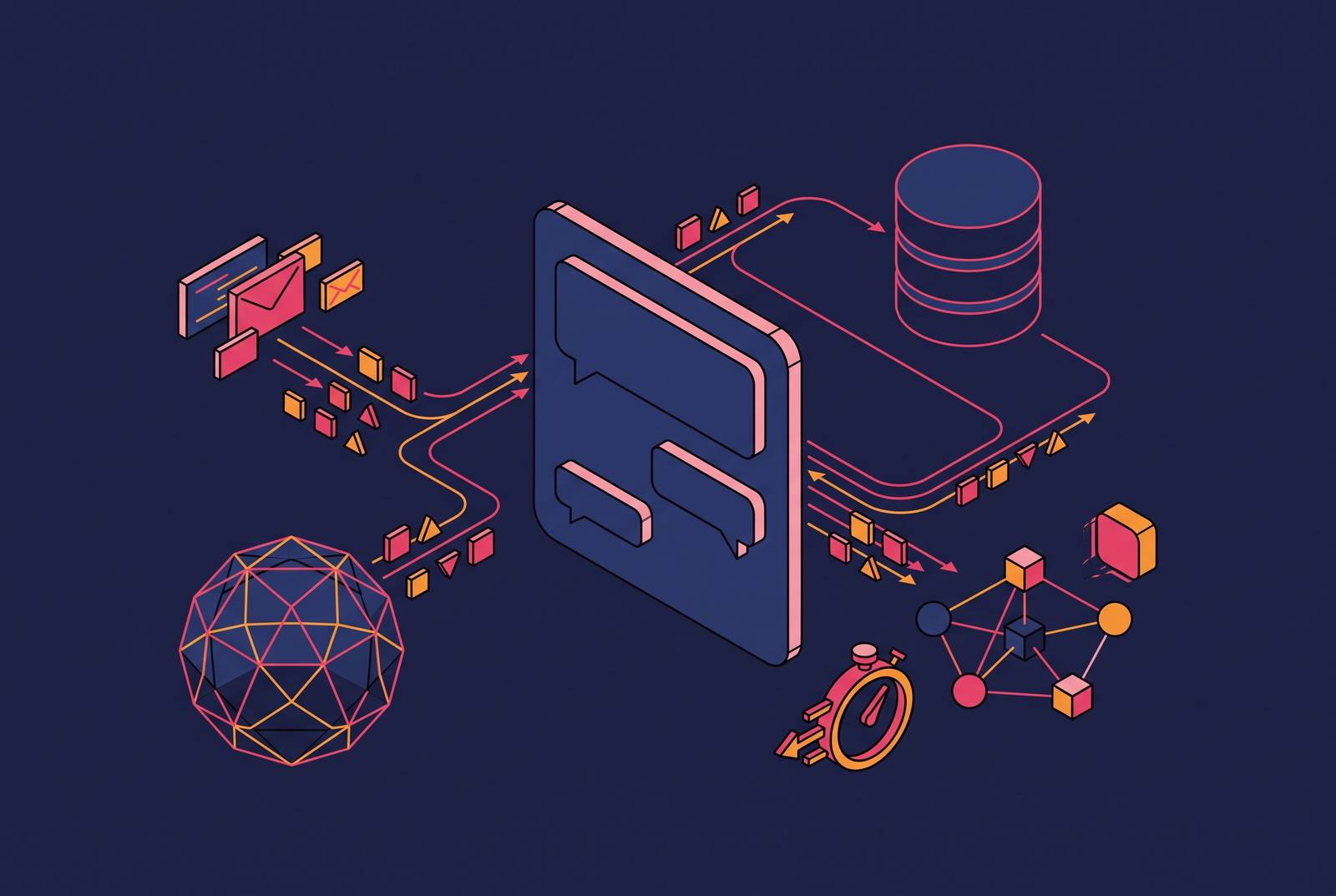
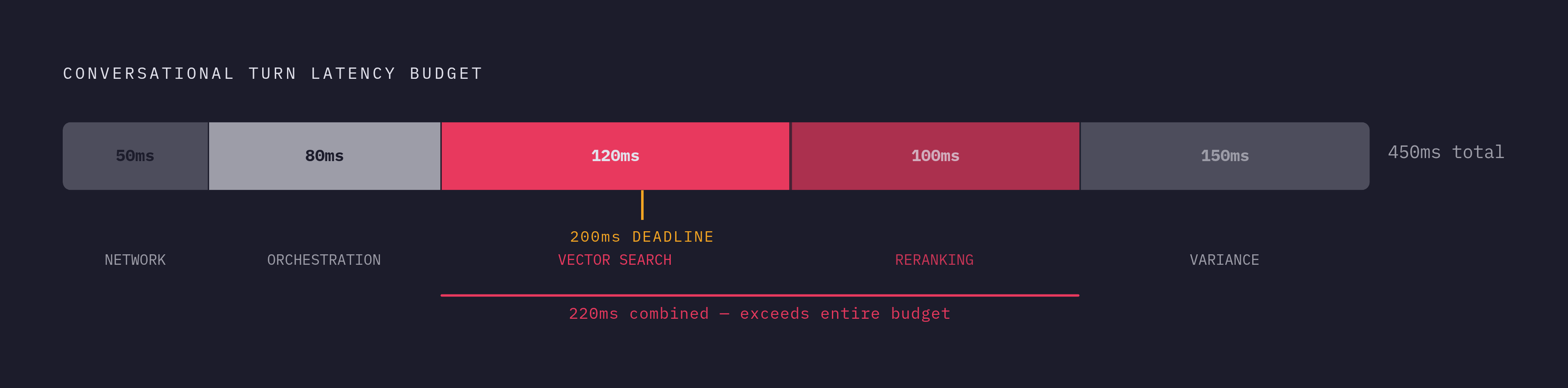
A person talking to a voice agent notices a 300-millisecond pause the way they'd notice someone stumbling mid-sentence. Conversational flow runs on a tight clock, and once a response takes longer than about 200 milliseconds to start, it stops sounding like a conversation and starts sounding like a system thinking. That's the budget retrieval-augmented generation (RAG) has to work inside, and it's a budget the standard pipeline blows almost by default.
RAG is the architecture most production chatbots rely on to ground their answers in outside knowledge rather than whatever the model memorized during training. The step that does the grounding, the retrieval step, pulls relevant documents from a vector database before the model can generate a word. Add embedding computation on top of that, then the generation step itself, and total latency already clears the 200-millisecond window before the agent has said anything. A single vector search can eat the entire budget by itself.
The breakdown of where that time goes makes the problem concrete. A single turn typically spends around 50 milliseconds on network and edge latency, another 80 on orchestration, 120 on the vector search itself, 100 on reranking, and a variance buffer of about 150 milliseconds to cover the inevitable unpredictability of live systems.
A RAG chatbot reruns retrieval on every turn of a conversation, not just the first, which makes this worse than a one-time tax. Production conversations run many turns on average, so a 200-plus-millisecond retrieval cost doesn't happen once. It happens again on turn two, again on turn three, and again on every turn after that. The cost is multiplicative across the length of the conversation. The problem compounds exactly where a longer, more engaged conversation should be rewarding the user with smoother interaction, not punishing them with repeated delay.
The obvious fix, swapping a stale pre-crawled index for live web fetching at query time, doesn't escape this. A live fetch keeps results current but adds its own network round trip and per-query cost directly onto the synchronous path the agent is already struggling to clear in time. For content that moves fast, like pricing, CVE disclosures, regulatory updates, or library versions, a static index answers a question about a world that no longer exists.
Raw HTML compounds the issue further. None of these fixes, a faster vector store, tighter reranking, a fresher crawl, live fetching in place of an index, change the fact that retrieval is on the synchronous response path by design. The real constraint is that every single turn has to pay that cost again, so the fix has to change where retrieval happens, not how fast it runs.
Decoupling retrieval from the response path as the foundational architectural move
The fix is removing retrieval from the synchronous path entirely, so fetching and responding happen at the same time instead of one after the other.
VoiceAgentRAG, an open-source dual-agent architecture from Salesforce AI Research, shows this pattern in a working system. It splits the work across two agents running on different clocks. A background agent, called the Slow Thinker, monitors the conversation as it unfolds, uses an LLM to predict what the user is likely to ask next, and pre-fetches the document chunks that answer would need, loading them into a semantic cache. Crucially, this happens while the user is still listening to the current response, before they've asked the next question at all.
A second agent, the Fast Talker, handles the user's actual next query. It reads only from the semantic cache the Slow Thinker already built, which gets it sub-millisecond lookup on a cache hit and skips the vector database step entirely. When the cache doesn't have what's needed, the Fast Talker falls back to the vector database just like a standard RAG pipeline would, then stores that result for next time. Nothing breaks on a miss. The system just reverts to the old path and gets a little smarter for the next turn.
The insight that makes this work is about timing, not speed. Every conversational turn has a window, the time the user spends listening to the current answer, that a standard pipeline simply wastes. VoiceAgentRAG treats that window as a pre-fetch budget and spends it on exactly the retrieval work the next turn is going to need. The architecture's shape comes from the System 1/System 2 framework in cognitive psychology, pairing one fast, reflexive process with one slow, deliberate process that runs underneath it. Applied to engineering, that becomes a cache that answers instantly and a predictive agent that keeps it stocked.
How predictive pre-fetching works in practice
Pre-fetching works because conversations aren't random walks. Someone asking about pricing is statistically likely to ask next about the enterprise plan, about discounts, or about billing cycles, not about something unrelated. That predictability is what gives a background agent something concrete to act on before the user has spoken.
Pre-fetching works best in warm turns, later in a conversation, where the trajectory of topics is easier to extrapolate from what's already been said. It's least reliable at the very start of a conversation, where there's no history yet to predict from. That's a structural limit, not a flaw in the prediction logic. There's simply nothing to extrapolate from on turn one.
A cache miss in this system is the designed fallback: the Fast Talker detects the miss, retrieves from the vector store the standard way, and caches the result, so even a wrong prediction leaves the system better prepared for the next turn.
The honest objection to this pattern is that predicting follow-up topics burns compute on topics the user never actually raises. Pre-fetching is the highest-leverage example of breaking that serial chain, but parallelizing the steps within a single turn's retrieval is a separate, complementary optimization worth doing regardless.
Applying the pre-fetch pattern to live web content specifically
The same decoupling logic that works for a vector database applies directly to the open web. A background agent can fetch live web content during the window the user spends listening to the current response, so that by the time the next query arrives, the foreground agent is reading from a fresh local cache instead of waiting on a live HTTP request mid-conversation.
The variable that decides which path a query takes is the freshness TTL. Content that changes constantly, prices, CVE disclosures, regulatory text, needs a live fetch, and the background agent should absorb that cost, keeping it off the user-facing response path.
Getting raw web pages into usable shape adds its own latency if it's done in the wrong place. JavaScript rendering and boilerplate stripping need to happen at the pipeline boundary, ideally through a managed API that hands back clean, LLM-ready Markdown, rather than inside the agent at the moment of the query, where that work adds directly to what the user feels as delay. Unmanaged scraping runs into bot-protection walls that a static vector store never has to deal with; pushing that problem onto a managed API keeps the pre-fetch logic clean and keeps failure modes bounded and predictable.
The resulting rule is straightforward: the background agent checks the cache TTL first. The foreground agent, the one actually talking to the user, never touches the live web directly.
Semantic caching as a latency hedge across repeated and similar queries
Semantic caching solves a different slice of the same problem. Where pre-fetching handles the retrieval cost for questions one user is likely to ask next, semantic caching handles the retrieval cost for questions that recur across many users and many sessions.
A semantic cache stores results indexed by the embedding of the query, so "what is the refund policy" and "how do I get my money back" can hit the same cached answer, collapsing two separate retrievals into one. Reactive semantic caches, systems like GPTCache, only help once a similar question has already been asked and answered somewhere. They do nothing for a question's first occurrence, and that's exactly the gap pre-fetching is built to close.
Put together, the two patterns cover most of the retrieval surface: pre-fetching handles the predictable next turn within a single conversation, and semantic caching handles repetition across different conversations entirely. What's left over, the genuinely novel query with no conversational setup and no prior occurrence, is the only case that actually needs to fall through to live retrieval.
The hard part of semantic caching is invalidation. A cache keyed on web content has to respect that content's freshness TTL, or it turns into a slower version of the exact stale index the whole architecture was built to avoid. When the source changes, its hash changes, and every cache entry tied to the old hash goes stale automatically, with no manual invalidation sweep required. That's a mechanical fix, not a cleverness problem, and it decides whether a semantic cache actually saves time or quietly serves wrong answers faster.
Streaming delivery as the user-facing complement to back-end latency reduction
Even a well-built pre-fetch and cache layer will miss sometimes, and when it does, streaming the response token by token changes how that wait feels even though it doesn't change how long retrieval actually takes. The same wait spent watching words appear one at a time feels shorter, because the user's attention has something to hold onto from the first token forward.
That's because the benchmark users actually judge an agent by is time-to-first-token, not total response time. The moment reading or listening starts, the sense of waiting resets. This lets a pipeline split its latency into two separate budgets instead of one: a fast time-to-first-token, served from cache or a lightweight model call, and a slower time-to-grounded-token, which covers the cases that need a live fetch to complete first.
Voice interfaces complicate this. Newer streaming TTS engines can start synthesis from just a few words, which narrows the gap but doesn't erase it. For a fully synthesized utterance, the architecture has to guarantee the complete cached result is ready before generation even starts. That's what makes pre-fetching load-bearing for voice specifically, not just a nice latency improvement. It's the mechanism that keeps the sub-200-millisecond conversational budget introduced earlier from collapsing the moment a live fetch is needed.
Where retrieval happens in an MCP-connected agent pipeline
A standard protocol for connecting agents to tools gives this whole pattern a general, reusable home. A Slow Thinker agent built to discover and call MCP-compatible retrieval tools works as a reusable architecture rather than something rebuilt from scratch for each new data source.
MCP lets an agent find out what tools a given server offers, read each tool's input schema, and call it through one consistent interface, with no custom integration code needed per service. A background pre-fetch agent built on top of MCP can connect to any MCP-compatible data source this way, including live web retrieval APIs, without rebuilding the connecting glue for each new source added to the system. The practical effect is that the integration tax, the weeks of custom connector work that used to delay shipping a new data source, compresses down to a single authenticated connection.
Getting that content into a usable shape inside the cache is its own design choice. Schema-driven extraction, using a developer-defined JSON schema, is the right way to pull structured content off the web. The background agent extracts only the fields the downstream response actually needs, which lowers token cost and improves the quality of what ends up in the cache, since the LLM is reasoning over exactly the data it needs.
A routing heuristic for deciding which queries go to cache, live fetch, or static index
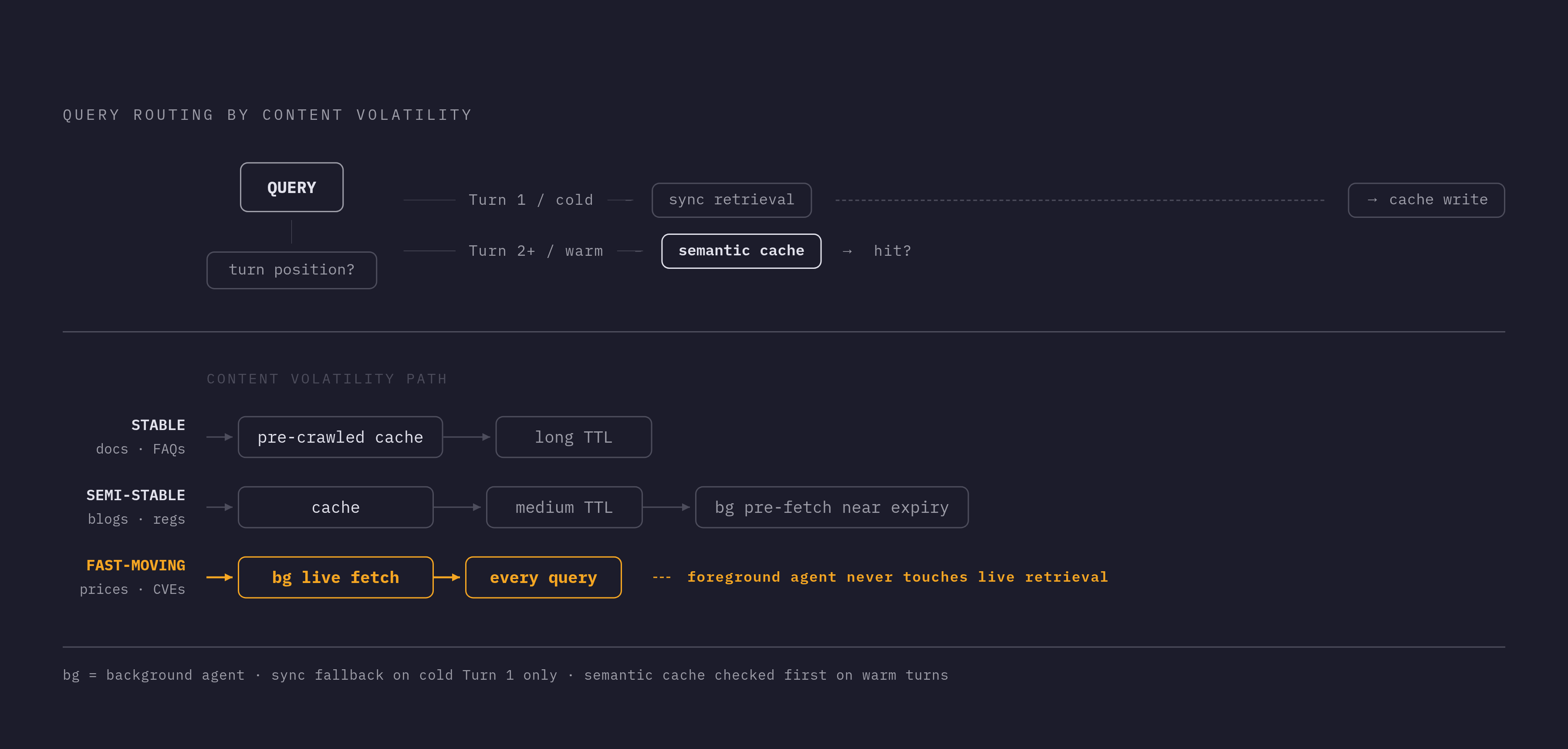
Not every query deserves the same retrieval path, and a simple routing heuristic based on content volatility and conversational position gives a working starting point without demanding exhaustive tuning.
- Stable content, like product documentation, company history, or public FAQs: serve from a pre-crawled cache with a long TTL, and trigger a live fetch only once that TTL expires.
- Semi-stable content, like blog posts, press releases, or regulatory text: serve from cache with a medium TTL, with the background agent pre-fetching fresh content as the TTL approaches expiry.
- Fast-moving content, like prices, CVE disclosures, earnings data, or live event information: route straight to a background live fetch every time, with the foreground agent either waiting for cache population before responding or streaming a bridging phrase while that fetch completes.
- Turn 1, the cold start: there's no pre-fetch history to draw on yet, so the system falls back to synchronous retrieval if nothing is cached, then kicks off Slow Thinker predictions to prepare for turn 2 and beyond.
- Turn 2 and onward, the warm turns: Slow Thinker predictions from the prior turn should already sit in the semantic cache, so the foreground agent checks cache first and only falls back to live retrieval on a miss.
The pieces needed to run this already exist at the API layer: managed web fetching handles rendering, anti-bot defenses, and Markdown conversion; MCP handles tool discovery across data sources; a semantic cache with TTL-aware invalidation handles storage. What's left for the application layer is the routing logic and the prediction heuristic that decide, turn by turn, which path a query takes.