JavaScript-Heavy Pages and Silent Data Failures in AI Pipelines
AI pipelines fail silently when HTTP succeeds but data doesn't.

A request goes out, a response comes back, the status code reads 200, and the pipeline moves on. The data inside that response can be wrong, partial, or stale, and nothing in the logs will say so. That is the core problem this piece is about: the gap between a successful HTTP response and a correct one, and why that gap is now the main way AI pipelines break.
A traditional pipeline failure announces itself. A 403 appears. A 429 appears. Something throws an exception, the job halts, and someone on the team gets paged. That kind of failure is annoying, but it's honest. The newer failure mode isn't honest. Scrapers don't crash anymore. They succeed, and still hand back the wrong thing. Pages load, but certain fields quietly go missing. Requests come back with a 200 and a body full of personalized junk or a bot-check page dressed up as content. A pipeline can run clean for weeks while the data underneath it slowly rots.
That changes what "healthy" even means for a pipeline. HTTP success rate used to be a reasonable stand-in for data quality, but isn't anymore. A pipeline can report 100% success on every request and still be feeding corrupted output into every downstream step.
For AI pipelines specifically, that corruption doesn't stay contained. Bad input doesn't just shrink the amount of usable data, it spreads. It gets baked into embeddings, split across chunks, pulled into retrieval, and surfaced in generation. The model doesn't hesitate or flag anything. It answers confidently, using the wrong information, and ordinary QA checks have no way to catch it.
Client-side rendering leaves a simple HTTP fetch structurally incomplete
Most pages built in the last several years aren't documents in the old sense; they're application shells, a skeleton of markup that only turns into real content once JavaScript runs in a browser. A plain HTTP fetch never runs that JavaScript, so it never sees the finished page. It sees the shell, and only the shell. That isn't a bug to patch, it's the design of how these sites work.
A typical page ships a bare-bones HTML document first, then uses client-side code to pull in data, fill out components, render the actual text, open tabs, or drop in content after some background request finishes. A simple HTTP client captures none of that second phase. It grabs a snapshot of the page before the page has become itself, and in doing so, it often collects a response that only partly represents what the page actually contains. Client-side rendering only fills in the useful content after JavaScript runs, so a static fetch arrives before anything meaningful is there. Asynchronous data fetching means whole sections of the page only appear once a background request to the server finishes, so the static version is missing exactly the parts a pipeline usually wants. Hydration-dependent layouts ship initial HTML that's full of placeholders standing in for the real text, rather than the final content itself. Complex DOM composition scatters content across nested components, shadow roots, or interactive containers that a plain fetch has no way to reach.
None of these four problems produce an error. The HTTP response still comes back clean, the status code still reads 200, and the markup still looks like a page. It just isn't the page a person would see in a browser.
This is where the damage to AI pipelines compounds. Noisy or missing text produces embeddings that are correspondingly degraded. Chunking produces segments with little real value because there was little real content to chunk. Agents end up reasoning over a partial picture of the world and have no way to know it's partial. Teams chasing this problem usually look in the wrong place first: they tune embedding models, adjust chunk size, rewrite prompts. None of that fixes anything, because the actual cause sits upstream of all of it. The source page was never rendered correctly in the first place, so everything built on top of it inherits the gap.
Behavioral detection and anti-bot systems turn rendering into a guessing game
Rendering JavaScript solves one problem and immediately runs into another. Even a scraper that correctly executes a page's client-side code can get served degraded or fabricated content by anti-bot systems built specifically to detect automated traffic, and those systems rarely announce that they've done it.
Before a request ever reaches real data, modern anti-bot defenses run through a stack of checks at once. TLS fingerprinting looks at the specific way a client negotiates its connection. JavaScript API presence checks whether the browser environment has the features a real browser would have. WebGL renderer strings and canvas fingerprints look for the subtle hardware and software signatures real devices leave behind. Behavioral biometrics track how a visitor moves, not just what they request.
None of these checks produce an error message when they catch something. A blocked or suspicious client doesn't get told it was blocked. It gets served something that looks like a page.
Structure drift makes this worse, and it's a 2026-era problem specifically. Plenty of website changes this year don't touch the HTML. Class names stay the same. Tags stay where they were. Selectors that worked last month keep matching something this month. The data coming out is still wrong, because the change happened somewhere a selector can't see: a configuration flag, a CMS rule, a piece of client-side logic that decides what content a given visitor actually gets. The markup looks stable. The meaning behind the markup has shifted even though the structure looks stable.
When these two problems combine, rendering becomes a guessing game. A headless browser can run every line of JavaScript on a page perfectly and still come back with content that's been quietly substituted, stripped down, or personalized into irrelevance, all under a response that looks completely normal.
The empty 200: the specific failure mode that makes silent corruption systematic
All of this collapses into one specific, nameable pattern: the empty 200. That's a response carrying the HTTP status code for success while the body contains a block page, an error message, or a CAPTCHA dressed up as content. It's the single failure mode most responsible for turning occasional data problems into corruption that spreads through an entire pipeline, because nothing about the response distinguishes it from a legitimate one.
A block page returning HTTP 200 with "Access Denied" in the body is structurally identical, as far as any status-code monitor is concerned, to a page that delivered what was asked for. Whatever sits downstream, an extraction layer or an LLM parser, will pull whatever text it can find from that block page and pass it forward into the pipeline as legitimate data. A 429 or a 403 leaves a trace. This leaves none.
Large web application firewalls, including Cloudflare and Akamai, commonly issue what's known as a soft ban: a fake HTTP 200 response carrying a CAPTCHA instead of the requested data. The pipeline sees the 200, marks the job a success, and moves on.
A quieter version of the same failure appears as a silent null. The scraper doesn't crash; it comes back with an empty price field while the address field next to it extracted just fine. That's worse than an outright failure, because a database that's slowly filling up with partial records poisons everything built on top of it, one field at a time, without ever once looking broken.
At scale, an isolated glitch turns into a single event with pipeline-wide reach. A target site changes one CSS class, and every extraction running against that site, for every record, starts returning silent garbage at once. That's a schema drift event that corrupts the whole pipeline simultaneously, and because no individual request technically fails, nothing fires an alert.
Standard QA has no foothold here. A RAG system built on top of this kind of corrupted data doesn't crash either. It answers questions confidently and wrong. Every dashboard tracking HTTP error rates reads green while the data underneath is already compromised.
HTTP status codes are the wrong layer to monitor
Because the empty 200 and its variants all return a successful status code, any monitoring built around HTTP error rates is watching the wrong layer. The place to look for this kind of failure is field-level data quality, not the transport layer sitting above it.
HTTP success rate tells teams almost nothing useful once soft blocks, personalized junk, and partial renders all come back marked as 200. Strong teams track completeness at the level of individual fields, not just whether a page loaded. If a scraper can't explain why a specific field came back empty, that's not a scraping problem to patch, that's a hole in the monitoring itself.
The fix is to alert on schema failure rates, the share of records where expected fields show up null, missing, or malformed, instead of counting HTTP errors. When a target site restructures something, the right alert is a sudden spike in null or malformed fields, not any event happening at the HTTP layer, because the HTTP layer never sees the problem.
RAG systems experience this same gap in a specific way. Pure embedding-based retrieval can only answer from documents that have already been indexed. For anything that changes faster than the indexing schedule, prices, library versions, security CVEs, regulatory text, the system hands back answers that were already stale the moment they were generated. No HTTP monitor will ever catch that, because nothing about the request failed. The data was just old.
Making field-level monitoring possible depends on a clean split in the architecture: the extraction layer handles rendering, proxies, and anti-bot evasion, while the pipeline layer owns validation, deduplication, schema conformance, and change detection. Without that separation, there's no layer whose job is to notice when the fields themselves go bad.
A rendering cascade designed to catch silent failures
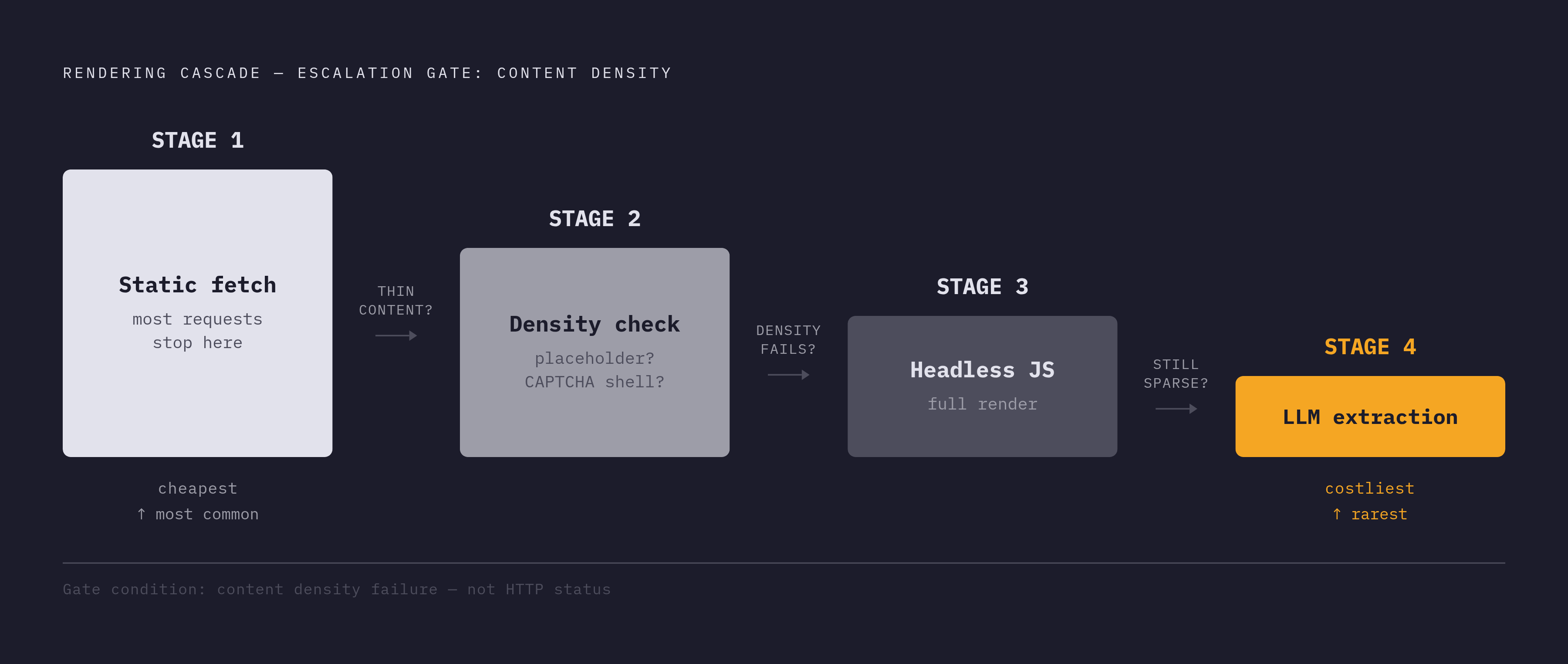
Rendering every request with a full headless browser would catch most of these problems, but it isn't affordable at any real volume. Headless rendering costs far more in latency and compute than a plain HTTP fetch. A well-built pipeline instead routes each request through the cheapest stage that can still produce complete data, and uses content density, not HTTP status, to decide when to escalate.
The common pattern is a tiered cascade: static fetch first, then a content density check, then a full JS render if the density check fails, then an LLM-based fallback if even the rendered page doesn't yield clean structure. Each stage only fires because the one before it came back thin, not because it came back with an error code. That ordering is what keeps the whole system affordable. Most requests resolve at the cheap static-fetch stage, and only the hard cases pay the cost of full rendering.
Content density is the gate that makes this work. After a static fetch, the pipeline checks whether the returned page actually contains a reasonable amount of meaningful text. If it's mostly placeholder markup, a navigation shell, or a CAPTCHA page, that's the signal to escalate, rather than quietly passing an empty result further down the line.
When a page does need the expensive stage, schema-driven LLM extraction becomes the fallback: the pipeline defines the exact structure of the data it wants and lets a language model pull that structure out of raw HTML. This approach handles cases where the page's DOM has drifted or its content is scattered across nested components in ways that break anything relying on fixed selectors.
One more piece belongs in this architecture: an explicit model of when a page is actually done loading. Waiting for the DOM to report "ready" isn't enough on its own. Production pipelines need a real definition of page stability: which signals mean the data is actually final, which events matter, and which can be safely ignored. Without that, a rendering stage can fire too early and capture the same kind of incomplete snapshot a static fetch would have produced.
Schema-driven extraction makes the failure mode detectable by construction
Traditional selector-based scraping has no concept of "complete." A scraper built on CSS selectors that comes back with a null price field still reports success, because the HTTP request itself went through fine. Schema-driven extraction closes that gap by design: it fails explicitly the moment a required field is missing or malformed, instead of quietly shipping a partial record downstream.
That shift matters because it turns the schema into a genuine contract between the data layer and everything built on top of it. The application depends on the schema, not on the target site's current HTML structure. When a site changes its markup, the extraction adapter is what updates. The pipeline logic above it never has to know anything changed.
This approach has become practical at scale because language models can now parse and structure raw rendered HTML directly, without needing a brittle set of CSS selectors tuned to one specific site layout. A February 2026 paper from Cairo University found that even a small-parameter model can reach state-of-the-art extraction accuracy once it's paired with intelligent DOM pruning.
For RAG pipelines in particular, this is what turns document quality from an assumption into something that can actually be tested. Bad extraction produces chunks in the wrong order, lost structure, duplicated text, or missing passages. A schema defines what correct extraction looks like before any of that happens. A pipeline can check its own ingestion quality directly instead of hoping it's fine.
Consolidating on a Single Rendering and Extraction API
Put all of this together, the tiered rendering cascade, behavioral detection handling, schema conformance checks, and field-level monitoring, and the result is a genuinely large piece of infrastructure. Building and maintaining all of it in-house means a team is spending engineering hours on work that doesn't differentiate their product.
Treating anti-bot detection as a moving target means someone has to track that target continuously, because every fix decays as detection methods evolve. For most product teams, that tracking work isn't where their advantage comes from, and every hour spent on it is an hour not spent on the actual product.
The strongest pushback to consolidating on a managed API is cost, since full JS rendering at high volume forces real architectural choices about when to render and when to skip it. The tiered cascade answers that directly: static fetch first, full rendering only when the content density check fails, keeps the expensive path rare rather than routine. A well-built API exposes that tiering as a parameter teams can control, instead of forcing every single request through the most expensive stage by default.
For RAG pipelines, pulling live web data through an API turns freshness into a TTL setting rather than a re-indexing project. The system can retrieve what's current right now, instead of answering from a snapshot that was already out of date by the time it got embedded.
There's also a plain speed argument. Getting from zero to working API calls in minutes, rather than the days or weeks it takes to stand up a rendering and extraction stack from scratch, lets a team test whether live web data actually improves their pipeline before committing to building any of this infrastructure themselves.
Sources
- Best Real-Time Web Content APIs for LLM Pipelines in 2026
- Best Web Scraping APIs for JavaScript-Rendered Sites in 2026
- Best Tools for Scraping JavaScript-Rendered Websites
- Best Real-Time Web Scraping Tools for AI Agents in 2026
- Best AI Web Crawlers and Data Pipeline Tools in 2026
- How to Fix HTTP Errors When Web Scraping (403, 429, 503, 520)
- Evidence-State Reliability Under Controlled Degradation: Parser-Validity Divergence in a Multi-Stage LLM Pipeline
- JavaScript Is Killing Your AI Visibility (Here’s How to Fix It)