Error States and Fallbacks When Live Web Data Is Unavailable in a UI
Classify failures at the fetch layer before they reach your model or UI.

Most of the engineering time spent on a UI that depends on live web data goes into the success state: the clean render, the populated table, the answer that shows up looking confident and correct. Failure is what a lot of users actually encounter, especially in networked or agent-driven interfaces where a dozen things have to go right in sequence before anything renders. Failure in these systems is not one event but a chain, and the chain has at least three distinct links: fetch, parse, and render.
The fetch layer fails when a request never returns usable content.
The parse layer fails differently. A response arrives, the request technically succeeded, but nothing usable can be built from what's inside it. A target site changes one CSS class and the extractor no longer recognizes the structure it's looking for. A page rendered on the client gets delivered as an empty shell, full of script tags and no content, because the fetch never waited for the client-side render to finish.
Then there's the render layer, where data has made it all the way to the component and the component still can't show it. An unhandled shape arrives where a flat object was expected. A null appears where a string should be. An error throws mid-mount and the whole component goes dark.
For systems built on agents and retrieval, the chain gets longer. Five layers, five different ways to break, and each one demands a different fix. Naming which link in the chain failed is the whole job before any fallback design can start.
How a fetch failure becomes a model hallucination unnoticed
The most dangerous failure in an agentic web pipeline rarely looks like a failure. What doesn't get noticed is a fetch that succeeds in the technical sense while delivering content that's completely wrong for the task at hand.
Consider what happens when a target site returns a Cloudflare challenge or a 403 in response to an agent's request. The agent receives that bot-detection page and treats it as the target content, with nothing to signal otherwise, and proceeds to attempt extraction from a page full of challenge widgets and "verify you are human" copy.
The RAG layer has its own version of this same problem, and it's arguably worse because it's quieter. The failure is a correct-sounding output built on outdated input, and fluency is what makes it convincing.
A geo and localization failure follows the same shape from a different angle. An agent running from a datacenter IP in one region requests pricing from a target site and gets back prices silently localized for that region, not the one the user actually cares about. The model has no way of knowing the numbers were localized, so it reports them with full confidence, and the user sees a wrong price presented exactly like a right one.
A fetch-layer failure that isn't explicitly classified before it reaches the model becomes, by default, a model-layer failure. The model has no mechanism for distinguishing a challenge page from a product page, or a stale chunk from a fresh one, unless something upstream labels the difference. Imprecision at the fetch layer doesn't stay contained there. It propagates, and by the time it reaches an answer, the answer wears the model's own confidence as a disguise.
Classifying failures before they reach the model or the component
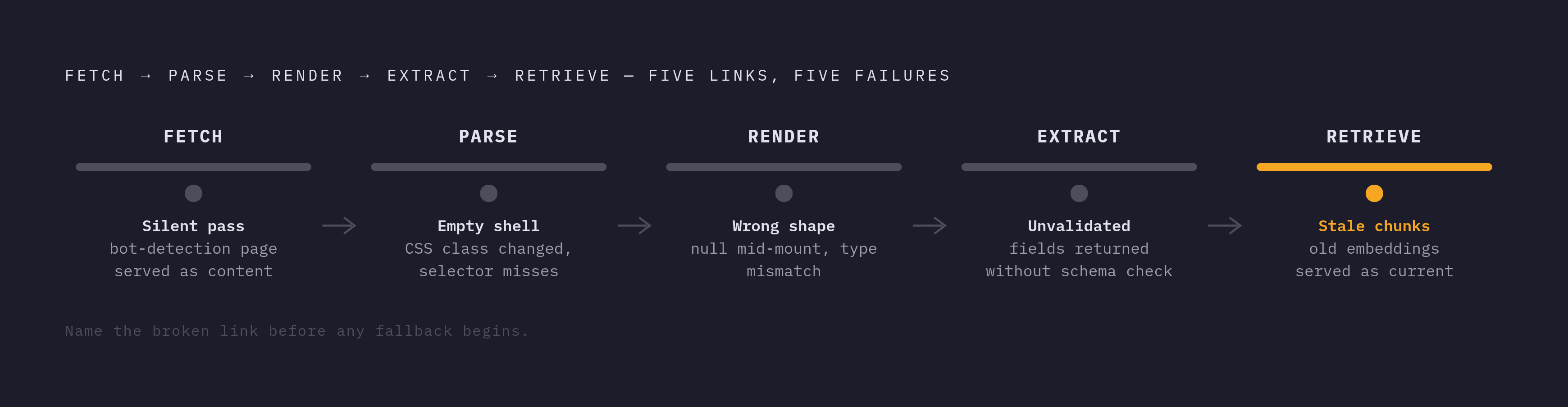
The earliest point at which a failure can be stopped is the earliest point at which it can be named. That's the argument for typed classification at the fetch layer: every result gets labeled before anything downstream, model or component, ever touches it.
A workable classification scheme needs at minimum five categories: transient network failure, rate-limiting, active blocking, schema mismatch, and success. A schema mismatch calls for a parser update or a partial-data response. Success calls for nothing at all, which is why it gets all the engineering attention and the other four get none.
The answer to that objection is that partial classification still beats no classification. A result flagged UNCERTAIN_CONTENT is safer to pass downstream than one marked SUCCESS, even when the precise cause of the uncertainty hasn't been pinned down. A model or a component that receives an honest "this might be wrong" can hedge accordingly. One that receives a confident SUCCESS label has no reason to hedge.
The same logic applies at the agentic extraction layer, where the prescription is a typed contract. A tool should return one of two things: validated fields mapped to a declared JSON schema, or an explicit failure code. Nothing in between, and nothing that merely resembles success without meeting its definition.
Schema drift is the high-volume version of this entire problem. AI-powered adaptive parsing addresses this directly by decoupling extraction logic from fixed selectors, so a single cosmetic change on the target site doesn't take down the whole pipeline.
What each failure class should show the user
A failure classification only matters once it changes what the user sees. The information displayed, the action offered, and the tone of the copy should all follow from the failure's class and from whether that failure is recoverable.
A transient network failure deserves a plain explanation of what happened, a retry action that re-mounts just the affected component rather than reloading the whole page, and, where it's safe and still useful, the retained stale content with a visible timestamp attached.
That last point, showing stale content at all, is a genuine design tension rather than a settled rule. Keeping cached data visible with a staleness note preserves usability and keeps the interface from going blank over a temporary hiccup. The right choice depends on how much damage a wrong number does if someone acts on it.
A blocked or bot-detected fetch, the 403 or the challenge page, should never surface its raw error code to the user. The interface should say directly that the data source is temporarily unavailable and offer either a retry or a path to escalate, not a blank panel with no explanation and no way forward.
A schema mismatch or an empty parse result is best shown as partial data. The component renders whatever fields it does have, marks the missing ones explicitly, and prompts a refresh instead of collapsing the entire view over one missing field.
Stale RAG grounding needs to be visible in the answer itself, not buried in a log somewhere no user will ever look. Every retrieved chunk should carry a fetch timestamp, so the model has a basis for flagging that its grounding might be outdated rather than presenting an old answer as a current fact.
One copy formula covers all of these classes, and it's worth keeping close at hand because it's the most reusable piece of this entire framework: say what happened, in plain status language with no apology attached. Say what remains safe: the user's data and session state. Say what to do next, as a single primary action.
Three things the UI must never do, regardless of which failure class is in play: render a raw error object as a string, producing the infamous "[object Object]" on screen. Show a blank screen when a component throws. Fall back silently to wrong data with no indication to the user that anything was substituted.
Structured fallback for RAG pipelines: the CRAG pattern and its limits
A RAG pipeline that retrieves irrelevant or stale chunks and hands them to a model produces a confident wrong answer, and no amount of UI polish fixes that on its own. The fix has to come from the retrieval architecture itself.
Corrective RAG, known as CRAG, formalizes a three-tier response to retrieval confidence. Low-confidence chunks discard the original retrieved documents entirely and trigger a live web search call instead of relying on whatever sat in the cached index.
A published research pipeline called HalluSearch, built for SemEval-2025 Task 3, implements a similar escalation with its own specific steps. If that still fails, the pipeline falls back further and prompts an LLM to generate a short textual passage as a last resort.
What this means for the interface is that a pipeline built with confidence-tiered retrieval can expose that confidence level directly to the UI. A component can then render something like "retrieved from live web" alongside a different answer labeled "retrieved from cached index, may be outdated," rather than presenting every answer with the same uniform certainty regardless of where it actually came from.
An infrastructure constraint that no amount of clever retrieval logic can route around sits beneath all of this. A RAG system is only as current as its most recent crawl. A pipeline that doesn't crawl continuously cannot offer live grounding, no matter how sophisticated its corrective retrieval tiers are on top of that stale index.
Implementing error boundaries and retry logic at the component level
Error boundaries exist to isolate failure, so that a crash in one data-bound widget doesn't blank out an entire dashboard or application shell. Wrapping major sections of an interface in boundaries is the minimum viable version of the cascade model this entire argument rests on.
The retry button matters because re-mounting and reloading are not the same operation. For a transient fetch failure, re-mounting is the correct response every time.
One real repository, tracked as livepage issue #92, shows what the render-layer anti-pattern looks like in practice: bare unstyled divs displaying nothing but "Loading…" text, or an error state that literally renders as "Error: [object Object]" because a raw error was interpolated into a string without ever being formatted into something readable. No retry affordance. No visual rhythm with the rest of the page. Just a raw object leaking into the page where a message should have been.
Stale data belongs in a staleNote pattern: a timestamped line, something like "Updated 12:03" or "Could not refresh. Showing data from 12:03," paired with a retry trigger. Never shown as if it were current. Never hidden outright when it's still useful information to have on screen.
A short accessibility checklist belongs here too, grounded in established accessibility guidance: error messages need role="alert" so assistive technology announces them without the user having to go looking. Skeleton placeholders need a screen-reader label describing what's loading, since a visual skeleton communicates nothing to someone who can't see it.
Fallback logic ownership: fetch layer, model layer, or both
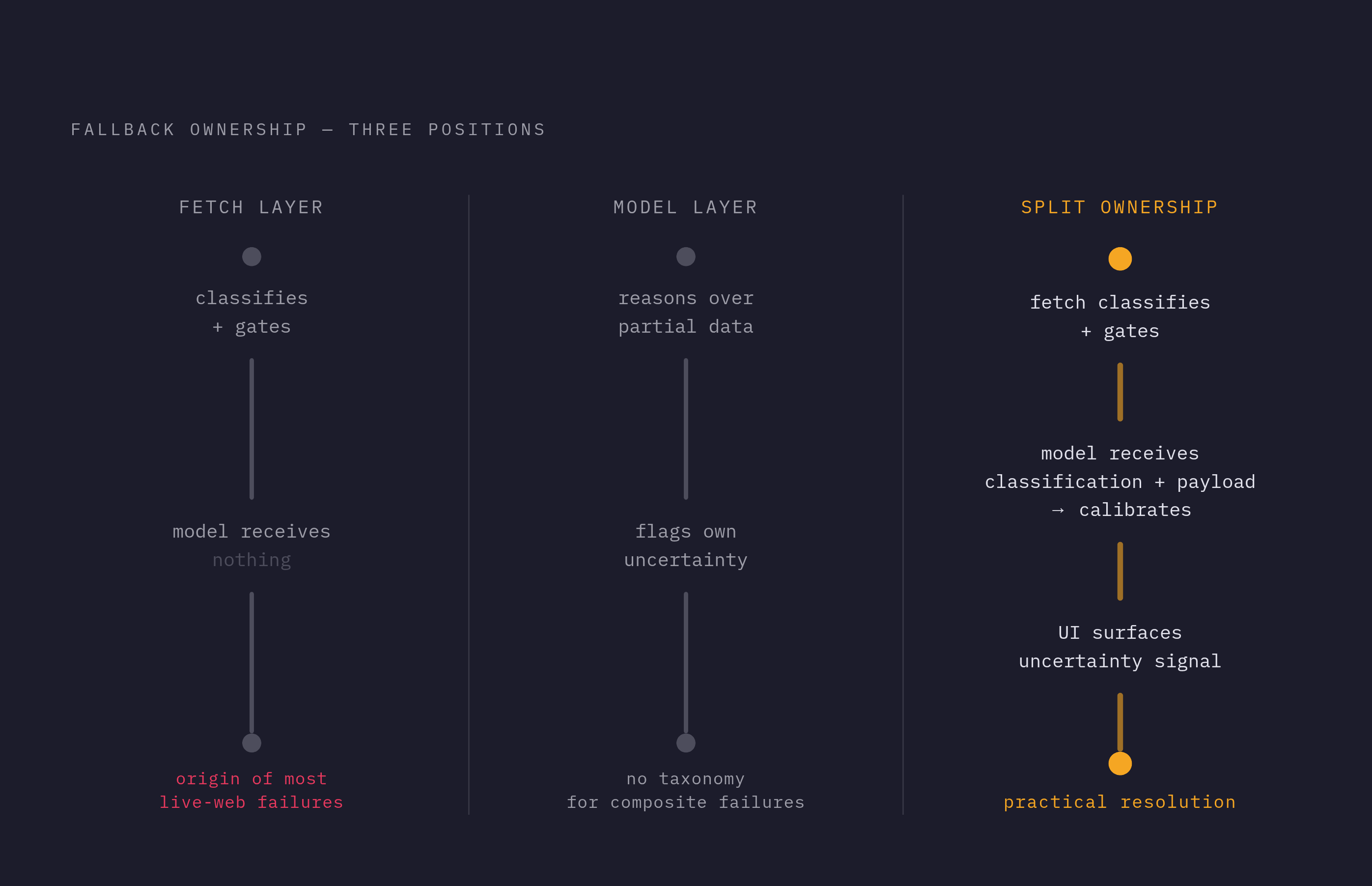
A real disagreement exists among people who build these systems over who should own fallback logic. One camp argues for the fetch layer: classify everything before it goes anywhere else. Another argues for the model layer: let the model reason over partial data and declare its own uncertainty. A third position splits the responsibility between the two.
The case for fetch-layer ownership rests on timing. It's the earliest point at which a classification can happen, before a bad payload reaches a model or a component. Most agent failures on the live web originate at the fetch layer specifically, so naming the broken layer there is the fastest route to an actual fix.
A model may have information available to it that helps it judge whether a partial payload is still usable, in a way a rigid fetch-layer taxonomy can't anticipate for every composite failure. An LLM capable of flagging its own uncertainty is safer than one that silently proceeds as though a partial or compromised payload were complete.
The practical resolution splits ownership rather than picking a single winner. The fetch layer classifies and gates what passes through it. The model receives that classification alongside whatever partial payload exists, and uses both together to calibrate what it outputs. The UI, in turn, renders the model's uncertainty signal explicitly whenever one is present, rather than flattening every answer into the same confident tone.
The same layered logic extends to change detection systems that feed automated pipelines. UI-facing alert tools, built to notify a human being, and API-first tools, built to deliver structured diffs to software, serve two different ownership models and shouldn't be confused for each other. An automated pipeline feeding a RAG layer needs a machine-readable diff it can parse directly. It has no use for a screenshot that requires a human to look at it and interpret what changed.
Building a failure-aware UI that distinguishes what users can act on from what they cannot
Every fallback state, in the end, comes down to one test: can the user do something with what's on screen? A recoverable failure should always offer a primary action. A non-recoverable one should say so honestly, without leaving the user stranded with no path forward.
Recoverable states, a transient network blip, a rate limit, a stale cache, should offer a retry or refresh action and keep showing whatever stale content is still safe to display while that retry resolves.
Non-recoverable states, a permanently blocked source, a schema failure that isn't going to fix itself, a permission denial, call for a plain explanation of the limitation, confirmation that the user's session and data remain safe, and a real way out: a back link, a support route, or a reference to a status page where the underlying issue is being tracked.
The design standard that falls out of everything above is simple to state and harder to actually ship: every component that depends on live web data needs an explicit plan for each failure class before it ever reaches production. Not a generic wall reading "something went wrong," but a state that answers three questions without fail: what happened, what remains safe, and what to do next.