Early-Stage Pricing Models for Web Data APIs and How to Budget for Them
Match your pricing model to usage volatility, not just the per-request rate.

Early-stage teams building on web data APIs make the same mistake over and over: they shop for the lowest per-request rate and treat that number as the whole decision. The number that actually sinks budgets is the mismatch between the pricing model and how the team ships, not the gap between two vendors' per-page prices. A flat subscription signed during weeks of pre-PMF experimentation pays full tier fees for near-zero usage. Pure pay-as-you-go signed right before a demo drives a traffic spike has no ceiling. Four or five pricing structures dominate this market: pay-as-you-go priced per request, subscription tiers with a fixed monthly commitment, and consumption-based credit systems that blend the two. Each converts usage into cost on a different shape, and the job at every stage of a build is matching that shape to how unpredictable the usage actually is, not chasing the cheapest sticker price.
How pay-as-you-go pricing behaves at the pre-PMF stage
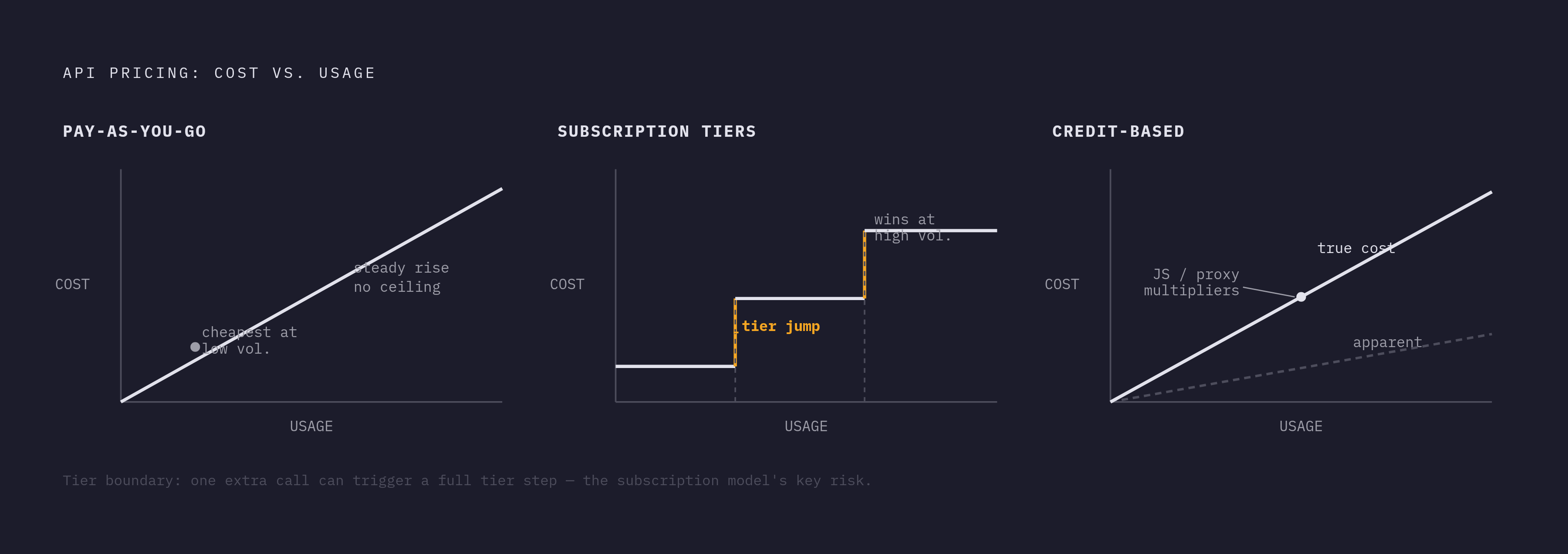
Before a product has found its market, usage of a web data API is spiky and impossible to forecast with any real confidence. That unpredictability makes pay-as-you-go the structurally sound choice: it charges nothing in the weeks when nobody touches the endpoint. Usage at this stage comes from developer experiments, investor demos, and small user pilots, not steady production traffic, so a fixed monthly commitment buys headroom nobody uses. A subscription bills the same amount whether the team ships five calls or five thousand that month. Pay-as-you-go turns that fixed cost into a variable one that tracks actual activity.
The crossover math is simple enough to run on a napkin: divide the subscription's monthly fee by the per-call rate, and if the real monthly call count sits above that number, the subscription wins; below it, pay-as-you-go wins. But the failure mode of pay-as-you-go is asymmetric. A subscription absorbs a spike up to its cap and stops there. Pay-as-you-go has no cap at all, so one unbudgeted crawl job or one feature that unexpectedly goes viral can erase a month's budget in a matter of hours.
The fix is to cap exposure before it happens, not after. Set hard spend limits or rate limits on the API client itself, before any outside traffic reaches the endpoint. Free tiers don't solve this problem either, because most web data APIs rate-limit their free tiers by monthly volume, not by requests per minute. They break under a burst of traffic well before they break under total volume, so a free tier is not a reliable stand-in for how pay-as-you-go behaves under a spike.
The real cost of credit-multiplier billing under request complexity
Credit-based pricing is the hardest of the three models to evaluate honestly, because the headline number on the pricing page hides a multiplier that can shrink real output by an order of magnitude. A base HTTP request typically costs a single credit. If you turn on JavaScript rendering, stealth mode, or residential proxies, that same page can consume many more credits. A plan advertised with a large monthly credit allowance can translate into a far smaller number of pages once the real request mix gets applied against it.
That gap between advertised credits and actual usable pages opens widest exactly when a team can least afford it. Production scraping increasingly needs JavaScript rendering and anti-bot handling, because the targeted sites have hardened their defenses over time. A team that priced its plan against simple HTTP requests and then moved into production against harder targets can find its effective page budget collapsing without any change in its nominal credit spend.
Evaluating a credit-based plan honestly means working backward from the actual request profile. Figure out what fraction of targets need JavaScript rendering, what fraction need residential proxies, and what fraction need structured JSON output, before comparing any two plans. Apply the full multiplier for that mix to get effective pages per month, not credits per month. Compare vendors on that effective-page number, because the headline credit price alone says almost nothing about what a team will actually get for its money.
When a flat subscription tier becomes the right shape
A subscription tier only pays for itself once monthly usage is steady enough that the committed rate beats the equivalent pay-as-you-go spend. Before that point, a subscription is unused headroom with a monthly invoice attached. The crossover arithmetic introduced for pay-as-you-go runs in both directions: once real usage crosses that line, the logic that favored per-call billing starts favoring a flat commitment instead.
Steady usage has a recognizable shape. A production feature that runs on a schedule, a daily competitive crawl, a weekly brand audit, a nightly refresh feeding a retrieval pipeline, generates volume that can be forecast within a narrow band. A subscription absorbs that kind of load cheaply, because the team is paying for predictable throughput rather than watching a per-call meter tick during every business-critical run.
The right trigger for switching is a pattern, not a single volume milestone. If you can forecast next month's call volume within a tight range, you can trust the subscription math. When the pay-as-you-go bill for the last two months has sat consistently above the cost of the next subscription tier, the switch has already paid for itself and the delay is pure cost. Subscriptions carry their own trap, though: tier boundaries often jump in large steps, so moving up for a handful of extra calls past a cap can raise the bill by far more than those calls were worth. Map the tier boundaries in advance, before usage forces a decision under time pressure.
The token tax: why the total pipeline cost of web data includes what happens after the API call
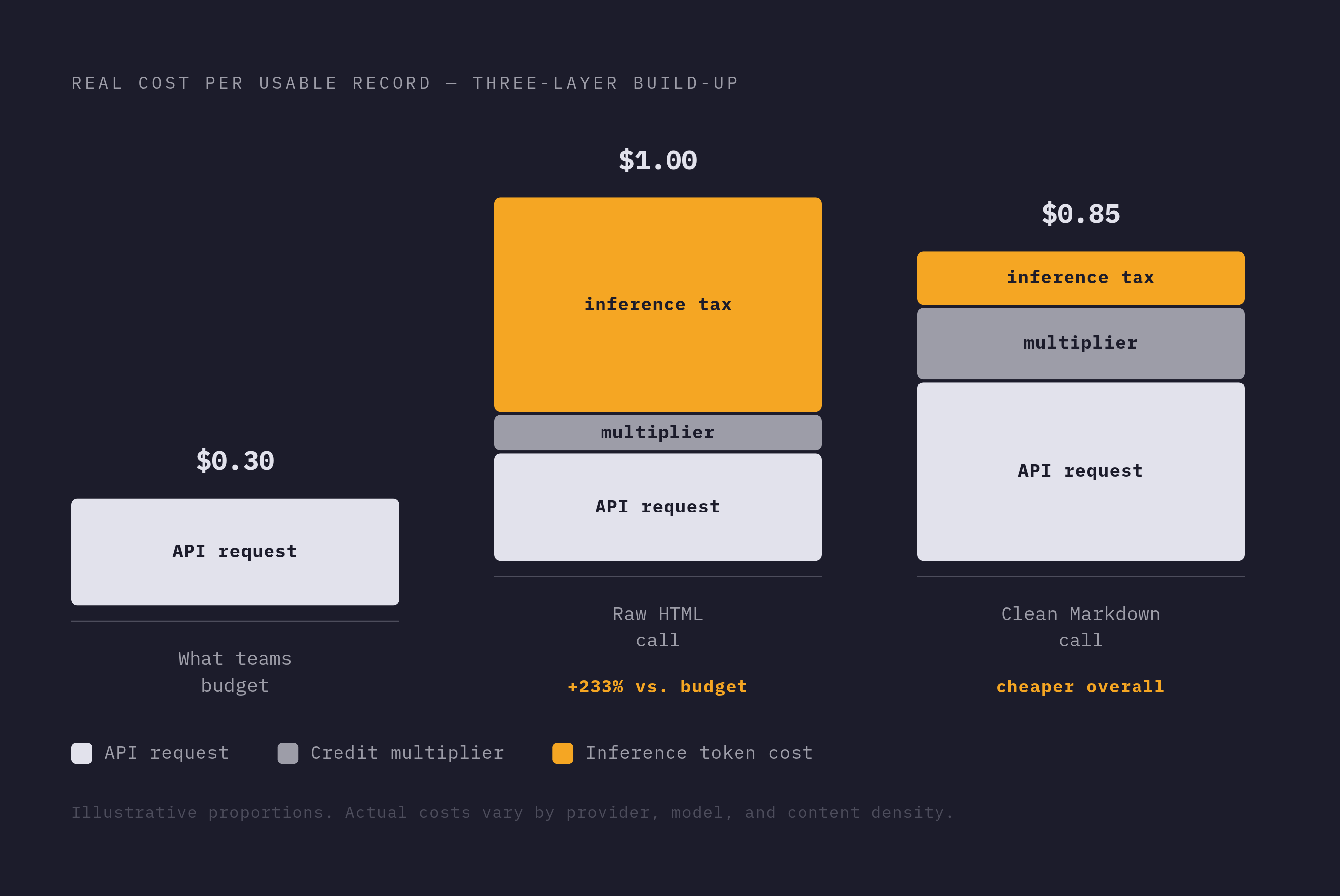
For any team feeding web data into an LLM pipeline, the API call with the lowest sticker price is not automatically the cheapest way to build the pipeline. Raw HTML priced low per request can cost more overall than clean Markdown priced higher per request, once the downstream inference bill gets added in. The reason sits in what the model has to do with what it receives.
An API that hands back raw HTML forces the model to chew through boilerplate, navigation menus, scripts, and ad markup alongside the actual content on the page. Every one of those extra tokens costs money at inference time, on every single call, for the life of the pipeline. If an API returns clean, already-structured Markdown, it cuts that token load out of every downstream call. The premium charged at the scraping layer for that cleaner output can be smaller than the savings it produces at the model layer.
Call this the token tax: a data source that looks cheap at the point of purchase becomes expensive once the model is stuck doing preprocessing work that a better-designed API would have handled already. The budget implication follows directly. The true cost per usable record includes the API call itself, any credit multiplier triggered by the type of request, and the inference cost of whatever content the API handed back. Teams that model only the first of those three numbers will consistently undershoot what the pipeline actually costs to run.
The cost model for schema-driven extraction pipelines
Schema-driven extraction means requesting structured JSON output by declaring the fields a pipeline needs, rather than writing CSS selectors to pull them out of raw markup by hand. That shift changes more than the output format. It changes the total economics of running the pipeline.
Selector-based scraping breaks every time a target site redesigns its HTML. Teams that maintain those selectors end up spending engineering hours on a repair loop instead of building product features. Schema-driven extraction hands the parsing decision to an LLM-powered API layer instead, so a site redesign doesn't force a scraper fix. The schema requested stays the same even when the underlying markup underneath it changes completely.
That stability has a price, and some credit-multiplier plans charge noticeably more for structured JSON output than for raw HTML. Paying that premium is worth it when it eliminates the engineering hours that selector maintenance would otherwise consume month after month. The real comparison to run is the API credit cost for structured output against the combined cost of a cheaper raw-HTML call plus the developer hours needed to parse and keep selectors working. Agentic pipelines benefit from this shift most directly: an agent that can request data by schema, rather than by selector, can retrieve what it needs on its own without a person maintaining the extraction logic between runs.
Real cost per usable record: failure rates, retries, and hidden overhead
The advertised price per API request is close to the least useful number in a web data budget, because it assumes every call succeeds. On hard targets, that assumption breaks down fast, and a cheaper API can end up costing more per usable record than a pricier one that simply works more often.
The honest way to compare two vendors is a failure-adjusted formula: real cost per usable record equals the advertised request cost multiplied by the number of retries needed, divided by the success rate, plus whatever engineering and QA overhead the team spends catching and fixing failures. A managed API that fails on most of its calls against a hardened target can produce a real cost per usable record far above its list price, in some cases higher than a well-tuned in-house scraping stack would have cost to run and maintain.
This is the strongest honest argument against assuming a managed API always wins on total cost, and it deserves to be taken seriously. The answer isn't avoiding managed APIs. It's doing real diligence before committing to one. Ask whether the vendor publishes success rates broken out by the type of target, e-commerce sites, gated content, social platforms, since failure rates vary enormously by target type. Ask whether retry logic is built into the API itself or whether the team has to build and maintain that logic on its own. Platform concentration adds a second layer of risk on top of failure rates: major platforms have changed access policies before, and a pipeline built entirely on one managed API loses its data source the moment that happens. Model what a pricing change or an access shutdown at a single vendor would do to the product before that vendor becomes the only path the data flows through.
A staged budget framework for matching pricing model to build phase
The pricing model that fits a product changes as the product moves through its build stages, and the same team should expect to sit on different pricing structures at different points on its roadmap rather than picking one model and staying on it by default. Planning for those transitions ahead of time is what prevents the budget surprises that catch most teams off guard.
In the exploration and validation stage, before product-market fit, pay-as-you-go or a free tier is the right starting point, because nothing should be committed until usage patterns are actually observable. The one non-negotiable guardrail at this stage is a hard spend cap set on the API client itself, before any outside traffic touches the endpoint, since the biggest risk here is an unbounded spike with no ceiling. That cap belongs at the client layer rather than relying on a vendor's billing system to catch it after the fact. Track actual call volume, the mix of request types in play (simple HTTP calls against JavaScript-rendered ones against structured-output ones), and the downstream inference cost generated per page returned during this stage.
In early production, once a product has its first paying users and usage is starting to firm up into something forecastable, the crossover calculation from the pay-as-you-go section becomes the deciding factor: if steady-state monthly call volume consistently clears the subscription break-even point, the move to a subscription tier is already overdue. This is also the stage to run the credit-multiplier math honestly, computing effective pages per month against the real request mix rather than trusting the headline credit number, and to introduce schema-driven extraction, since the reduction in ongoing maintenance work pays back its credit premium before engineering costs have a chance to pile up.
In scaled production, where scheduled crawls, agentic pipelines, and multiple features are all drawing on the same data layer, a subscription or a hybrid model combining a base commitment with overage pricing is the right shape, because it gives a forecastable floor while still covering the occasional spike. This is also where the token tax and the failure-adjusted cost formula carry the most weight, since the full pipeline cost, not just the API line item, is what determines whether the product is actually profitable to run. Consolidating onto a single well-designed API, rather than running separate vendors for scraping, crawling, and structured extraction, cuts down the billing surface area a team has to track and avoids the problem of two vendors each billing their own half of the same job.