Building a Web Research Tool for an Autonomous Agent With Structured Output
How to give autonomous agents fresh, structured data from the web.
Building a web research tool for an autonomous agent requires a web scraping pipeline that selects a source, fetches live content, converts it into usable text or JSON, enforces an output schema, and keeps the result current. Reliability comes from separating those jobs. The agent should receive fresh, typed data it can act on.
Why autonomous agents cannot rely on model memory alone
Model memory stops at the training cutoff. It cannot reliably supply recent prices, current availability, live documentation, or policies that have changed since training. More prompting cannot fill that missing knowledge. Long-tail companies and niche topics make the gap worse because coverage may have been thin even before the cutoff. Web grounding at query time addresses this temporal blindness by fetching current content for the agent to reason over and cite.
That dependency extends beyond retrieval-augmented generation, or RAG, to any agent acting on changing information. A shopping agent checking a price needs a current source. Its web research tool is a callable function with a defined signature, which accepts a URL and returns clean Markdown or structured JSON within a single request cycle. The agent invokes it during reasoning, waits for the result, and acts without a human passing data between steps. Unlike a generic scraper or search wrapper, this tool must fit directly into the agent’s function-calling interface.
How to choose the right data source before writing any extraction logic
An official API or public XHR/JSON endpoint is the first place to check for the needed data. If it does not, the next place to look is embedded JSON in the page source, including Next.js hydration blobs, JSON-LD, or __NEXT_DATA__. Only after those routes fail does browser-rendered HTML through a tool such as Playwright become the next candidate. Raw HTML parsing follows, with LLM extraction reserved for small, reviewed cleanup when the cleaner paths do not fit.
Each branch of this decision tree has a failure mode that can rule it out for a particular job. An API route can fail when the needed endpoint is private, while embedded JSON can disappear after a framework change. Browser automation needs proxy infrastructure at scale, and HTML selectors can break when a site is redesigned. Passing the whole problem to an LLM does not remove those trade-offs because model extraction is too costly and slow for high-volume main-pass work.
For a one-off request, the agent can inspect the page and choose the cleanest available source. For recurring production work, that choice should become a fixed, audited decision implemented in deterministic code with logs, retries, and tests. Exploration finds the route through the site. Production code makes that route repeatable without paying for another model decision on every extraction.
Fetching live, LLM-ready content: what the ingestion layer must do
After the source is chosen, ingestion turns a URL into content the model can use. Raw HTML is a poor handoff because it spends tokens on page machinery. Clean Markdown preserves heading hierarchy and content structure without that burden. It also gives chunking and embedding pipelines usable input without another preprocessing step.
Getting that content is the harder job. JavaScript-heavy sites may return an empty shell unless the fetcher renders the page, while bot detection can reject the browser before useful content arrives. Cloudflare, Akamai, and PerimeterX use multiple detection layers, including network/TLS fingerprinting, JavaScript browser fingerprinting, rendering checks, and behavioral analysis. An LLM directing standard headless Chromium does not make those checks disappear. Direct navigation, irregular timing, and missing scroll events can make agent-driven browsing more detectable.
Teams should avoid building and running this infrastructure themselves. An in-house stack means operating a Playwright fleet, proxies, parsing, and monitoring as target sites change. The fetch API should do that work and let the caller make the choices it needs to make. A freshness parameter such as maxAgeMs is a useful example, allowing a sensible default while letting the caller express anything from “must be live now” to “yesterday is fine.” That contract should come with low-latency, on-demand fetching because the reasoning chain has to wait for the response.
Wrapping the fetcher as a callable agent tool
A fetch API becomes an agent tool through an explicit interface. The tool has a name, a description explaining when and why to use it, and a typed input schema containing at least a URL string. LangChain, LlamaIndex, and custom OpenAI function-calling loops can work with this kind of definition. The description guides the call decision. The signature sets the boundary between what the agent requests and what the tool promises to return.
The agent framework handles the decision to invoke the tool, the tool fetches, renders, and formats the source, and the agent decides what to do with the result. Putting browser-specific decisions into agent reasoning tangles the interface with the fetching implementation. A stable contract avoids that coupling. The agent can request current content without needing to know how the page produced it.
MCP addresses connector compatibility. It reduces the N×M integration problem, where each AI application needs a custom connector for each tool or source, to N+M integrations. That simplifies connection work but does not establish trust. MCP-connected deployments can expose governance risks involving malicious code execution, remote access control, credential theft, and missing authentication or authorization. Teams deploying those tools should audit the trust boundary rather than treating the protocol itself as a security layer.
Enforcing structured output with a JSON schema
With free-form text, the calling model has to do more parsing. A sentence describing a price may be readable, but it does not provide the same interface as a validated record with separate price, currency, and billing-cycle fields. JSON Schema makes those expectations explicit. The developer defines the needed fields, the extraction layer returns data that conforms, and the agent receives a typed record for programmatic use. A product title can be a string, a price a number, and availability a boolean.
That contract is an architectural requirement. Markdown suits prose the model needs to reason over, while schema-enforced JSON suits fields that drive an action. The schema also documents the tool for developers and, when included in the tool definition, for the calling model. Its guarantee is about the output’s shape. Fresh sourcing still has its own job because a correctly typed price can come from outdated content.
Schema-driven LLM extraction also has real limits. Complex nested schemas are difficult for models, and deeply hierarchical entity recognition can perform substantially worse than traditional methods. Production schemas should thus be flat and explicit, and deeply nested extraction should be kept for exploratory work that a human checks before it goes into a pipeline. Schema enforcement defines the output contract, but it does not require every field to be extracted by an LLM.
Handling the cases where simple fetching is not enough
The simple path ends when a single URL cannot supply usable content by itself. Pages that rely heavily on JavaScript need rendering, authenticated sites need access, and some sites spread the needed information across linked pages. Rendering belongs inside ingestion, which should return the same clean Markdown whether the page was server-rendered or client-rendered. The calling agent should not need to distinguish them.
Authentication needs a different response from rendering. Most production agent tools should not try to automate authenticated sessions on third-party sites. Official APIs, XHR endpoints, or vendor data partnerships belong at that boundary. When data is spread across linked pages, one fetch cannot be assumed to have captured the whole source. That limitation changes the scope of collection without removing the need for clean ingestion and a defined output contract.
Unstructured content is where agent-native extraction has a stronger case. Product specifications buried in prose and review summaries may have no clean CSS selector or XHR endpoint mapping to the requested field. Natural-language extraction can find that information more effectively than brittle selector engineering. The advantage is specific, not universal. It fits one-off tasks and targeted cleanup, while calling the model over and over in a high-volume main pass adds to both cost and latency.
Keeping the agent's knowledge current with change detection
A page fetched once is only a snapshot. If the result stays cached indefinitely, the tool no longer supplies live knowledge, even if its first extraction was accurate. RAG systems inherit the same weakness when an indexed document outlives the facts on its source page. Embedding content does not preserve its truth.
Freshness maintenance therefore needs invalidation on change alongside a time-to-live refresh. When monitoring detects a page change, it triggers a re-fetch, re-extraction, re-chunking, and re-embedding for that document. The rest of the index stays untouched. This costs much less than rebuilding the whole index to catch one changed page. Change detection is part of the data pipeline because it determines which knowledge remains fit for use.
A webhook can turn that change into an automated event. Conditional logic examines the payload and triggers re-extraction and re-embedding if the monitored field changed, or discards it if the field did not. Schema-driven monitoring makes this more useful by running a defined extraction on a schedule and returning the current record in the developer’s schema. A changed price is a semantic change. A renamed CSS class may only be a syntactic one, so raw page differences alone are a poor guide to what the agent needs refreshed.
How do you build a reliable web scraping pipeline from URL to agent action?
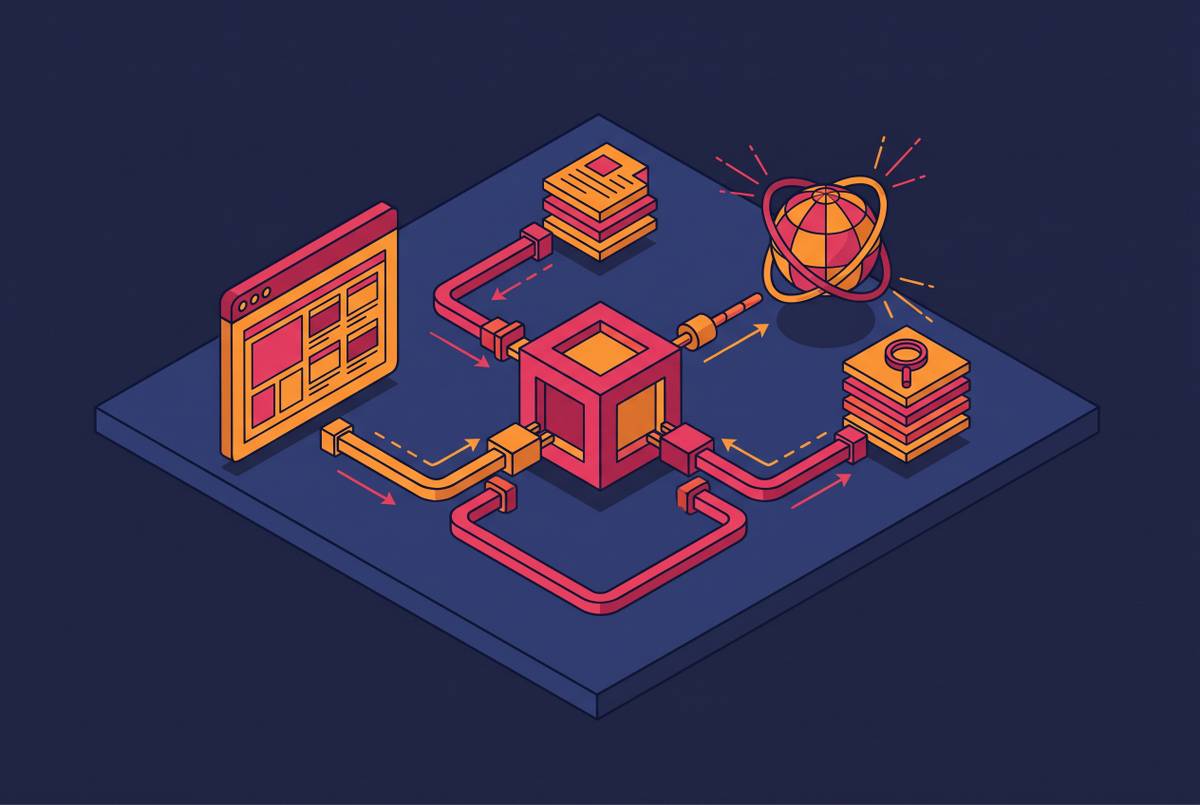
The full architecture has five layers, each with its own job. Source selection chooses the cleanest route before extraction begins, starting with API/XHR data and then embedded JSON before rendered HTML. Ingestion handles the on-demand fetch, JavaScript rendering, anti-bot measures, and proxy management. Format conversion prepares Markdown for reasoning or JSON for programmatic use, with the choice expressed at call time through the schema parameter. Schema enforcement validates the typed record, while change-triggered freshness maintenance updates the affected knowledge when its source changes.
The callable tool is the agent’s entry point into that architecture. During reasoning, the agent asks for a URL through the defined interface and waits for content it can use, leaving the work of collecting it to the tool. The agent then decides what action to take.
The layers can have separate jobs without each being bought separately. When a team puts together a scraper, renderer, proxy provider, and monitoring service from point solutions, it has to keep every integration working and deal with changes to each interface. Consolidating those services can reduce that work while preserving clear responsibilities inside the pipeline. A working API call should take minutes before agent features can begin. The production payoff is composability, where a developer can replace a component without rewriting the agent’s reasoning logic.