Handling Enrichment Failures and Fallbacks in Signup Flows
Build enrichment systems that gracefully fail instead of blocking signups.
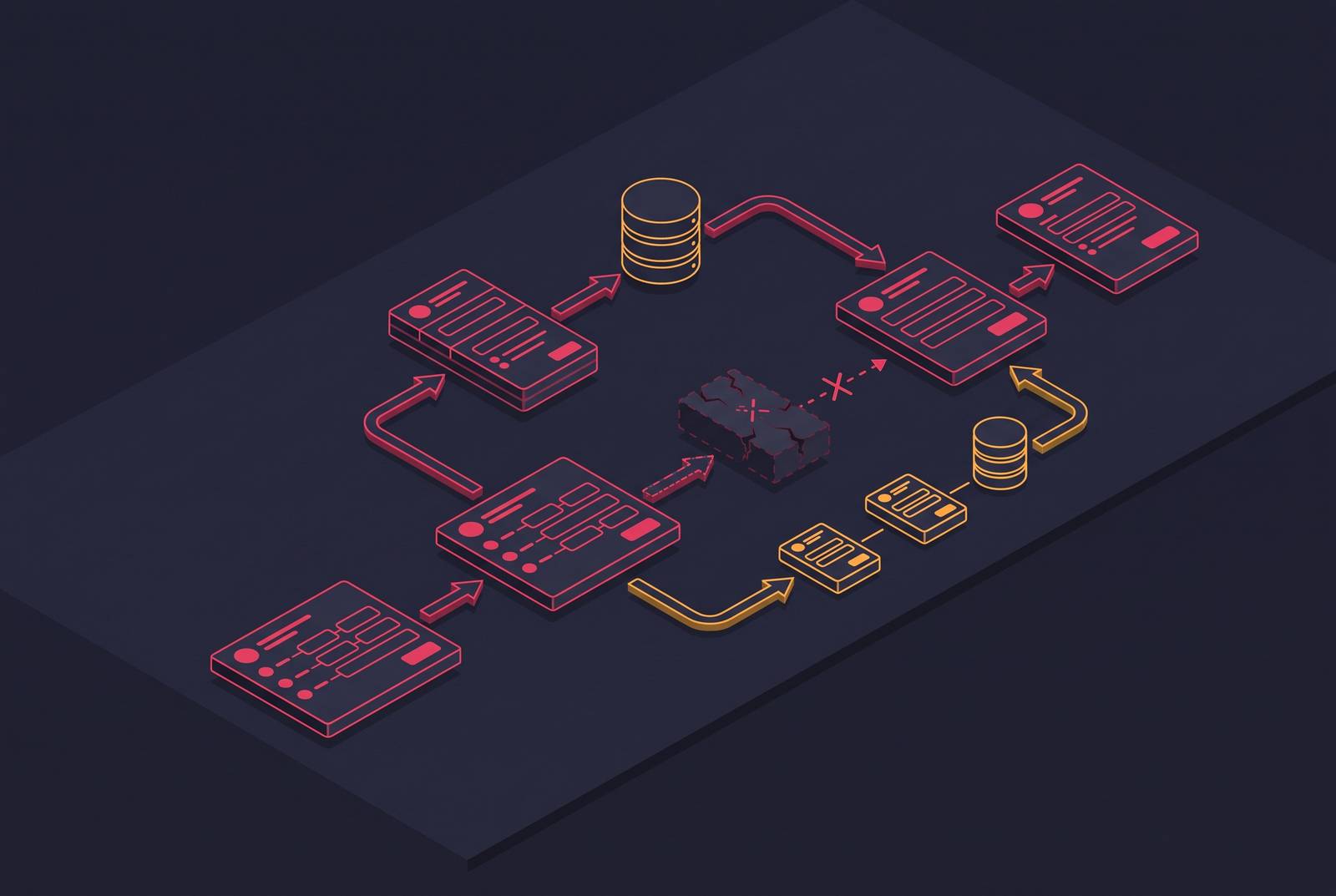
Enrichment fails constantly in a signup flow. That's the baseline, not the exception, and pipelines that hold up under real traffic are the ones built assuming failure rather than hoping around it.
The pitch behind most enrichment APIs sounds simple: send a domain, get back company size, industry, revenue band, and job titles for every contact tied to it. In practice, that promise breaks in at least four separate ways, and each one needs its own fix, not a shared one.
Start with coverage. A single-source provider typically covers somewhere between 60% and 75% of records it's given, according to Pintel. The rest come back blank, no error, no failed request, just an empty field sitting where a company name should be.
Then there's identity resolution, which usually isn't the provider's fault at all. Feed a system "John" and "Acme" and it has almost nothing to work with. Matching against a database of hundreds of millions of contacts needs a real anchor: full name plus a company domain, or full name plus a social profile URL. Anything thinner than that, and the miss is expected behavior. It's just math.
Geography adds another layer. Coverage across the US and UK tends to be solid. Move into Southeast Asia, Latin America, or Africa, and completeness and accuracy both drop off hard for the same providers.
Then there's staleness, which nobody notices until it costs them a deal. A title, a phone number, an email that looked fine the day someone signed up can be wrong six months later, and without a "last updated" timestamp on the record, there's no way to tell fresh data from a fossil. Treat anything enriched more than 90 days ago as stale until proven otherwise.
None of these four failures throw an error. That's what makes them dangerous. The record just sits in the CRM looking complete, and by the time anyone notices, bad data has already fed a scoring model or a segment list.
Most teams get this wrong by treating all four as one problem and slapping a "retry on failure" policy over the whole thing. That fixes almost nothing. A timeout needs a retry. A coverage gap needs a different data source. Those aren't the same problem wearing different clothes, and one fallback built for both means neither actually gets solved.
Graceful degradation is the right design choice here, not a buzzword to nod at. A system built to fail gracefully keeps working in a reduced state when a piece breaks, instead of stopping cold, which is the opposite of fail-fast, where any error halts the process and throws up a warning immediately. At signup, the difference is concrete: an enrichment call that times out should never hold up form submission or delay the confirmation screen a new user is staring at. Enrichment is extra context wrapped around the real transaction, which is getting someone signed up, and the two need to be decoupled completely.
The working principle: show whatever data exists right away, push enrichment into a background queue, and let retries happen with exponential backoff instead of hammering an API that's already struggling.
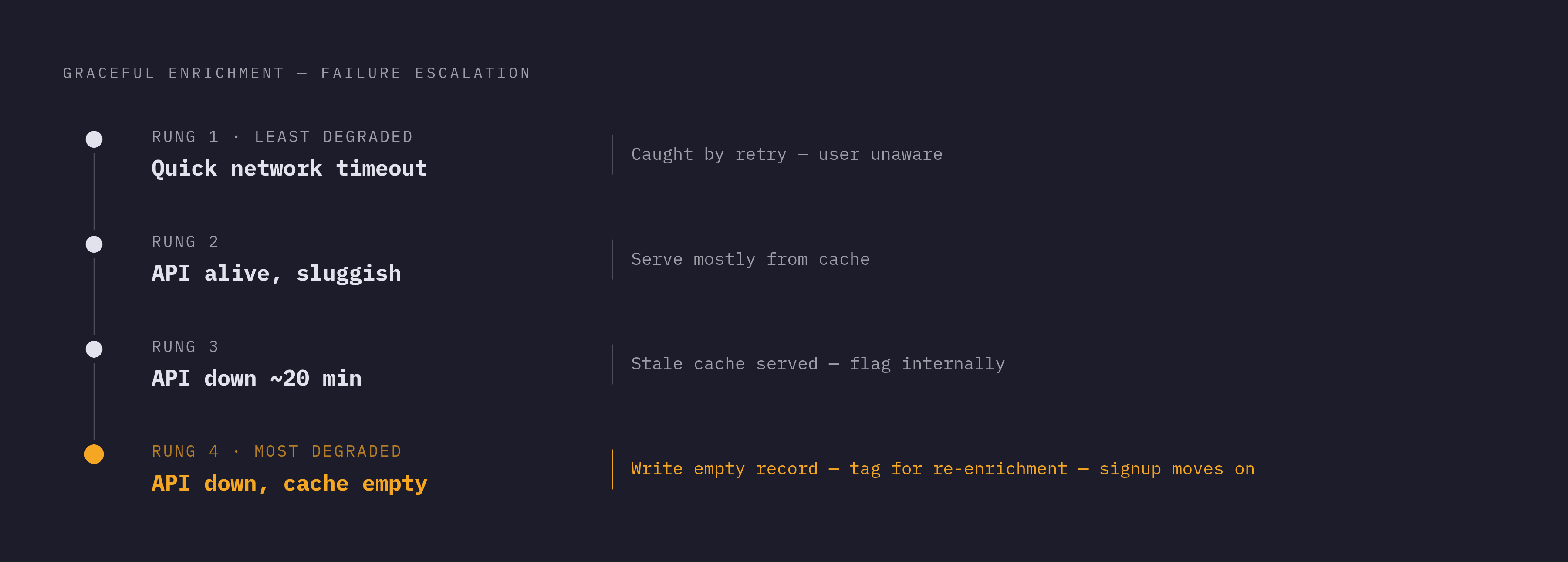
Think of the failure states as rungs on a ladder, each one calling for less than the one before it. A quick network timeout gets caught by a retry, and the user never even knows it happened. An API that's alive but sluggish gets served mostly from cache, so load on the provider drops way down. If that same API goes dark for twenty minutes, fall back to stale cache and quietly flag internally that the data is running behind. And if the API is down and the cache is empty too, write an empty enrichment record, tag it for a re-enrichment pass, and move the signup along anyway.
Every one of those degraded outcomes needs a label. An enrichment_status field, tracking pending, partial, failed, or stale, forms a core part of the data model. It tells every downstream system whether a record can be trusted. Watching three numbers, the rate of third-party API calls, the cache hit rate, and the size of the enrichment backlog, is usually enough to catch a provider going sideways before it turns into a full data quality mess.
The field-level quality threshold that determines when a fallback is actually needed
An empty field is an obvious problem. A field that's technically filled but useless is the one that slips past most QA processes, and it's the more dangerous of the two.
Fill rate is the number that actually matters here. A field that fills below 70% of the time is a liability for targeting, and anything under 40% should get treated as if it isn't there at all. A provider returning job title 38% of the time is, for practical purposes, returning nothing. Any scoring model or routing rule built on top of that field misfires quietly, record after record, until pipeline numbers look off and nobody can say why.
Judging a field takes more than one lens anyway. Four questions matter: is it there at all (completeness), is it right (accuracy), when was it last checked (freshness), and is it formatted the same way across every record (consistency)? Skip any one of these and the field looks fine on a dashboard while quietly poisoning whatever gets built on top of it.
Self-reported fields bring their own mess. Ask someone their job title on a form and you'll get "Growth Hacker" next to "VP of Revenue" next to "Ninja." None of that matches a standard B2B taxonomy, so it has to get normalized before it feeds into any enrichment logic or gets used to build a segment.
A data quality score, scored 0 to 100 across those four dimensions, gives teams one number to act on. Anything under 50 gets pulled from active targeting and routed into a re-enrichment queue instead of getting written into the CRM as if it were finished. Know a field's fill-rate floor before picking a fallback strategy for it. Different fields deserve different depths of fallback effort, and treating them all the same wastes engineering time on fields nobody's using anyway.
Waterfall enrichment as the primary architectural response to coverage gaps
Single-source enrichment tops out somewhere in the 60% to 75% range no matter how good the provider is. Chain several providers together in a waterfall, though, and completeness climbs to somewhere between 90% and 95%. That gap alone is the argument for building a waterfall instead of betting everything on one vendor's coverage.
The mechanic is simple: query one provider, and only move to the next if the first one comes back empty or below the fill-rate threshold. Extra provider calls only happen on records that actually need them, which keeps cost from spiraling.
There's a real architectural fork here between sequential and parallel waterfalls, and most teams pick the wrong one by default. Sequential queries providers one at a time, in priority order, and stops at the first match. That keeps costs down, but a lower-quality match from provider one can win over a better one sitting at provider two, and there's no way to catch that after the fact. Parallel queries every provider at once and keeps whichever result has the highest confidence score, fixing that accuracy ceiling, but it costs more per record since multiple providers get billed on the same lookup. If margin matters more than precision, run sequential. If it doesn't, run parallel, and stop treating the choice as a coin flip.
The provider landscape breaks down roughly like this. Clay pulls together multiple sources, including Apollo, ZoomInfo, and Clearbit, and works well for teams that want to orchestrate several vendors in one workflow. People Data Labs is considered developer-first, with strong SDKs and documentation for anyone building single-source enrichment directly. ZoomInfo leans strong on enterprise coverage in one major region. Apollo.io does well with SMB data. Lusha has notable strengths in certain geographic markets. Databar runs the waterfall logic internally across multiple sources, so one API call returns whatever the best-matching provider has, without the caller managing the cascade itself.
Running more than one provider serves a purpose beyond filling more fields, too. It's insurance. If one vendor changes its pricing overnight, degrades its API, or loses a data partnership, a single-source pipeline breaks completely. A waterfall just routes around the gap.
Compliance needs a second look here too. Providers in the same cascade don't necessarily collect or handle consent the same way, and stacking several together without checking each one's practices raises GDPR exposure in the EU. That's a design review, not an afterthought.
And budget for the worst case up front. In low-coverage segments, a sequential waterfall might end up querying every single provider before finding a match, and that per-record cost needs to get modeled before launch, not discovered for the first time on a billing statement three months in.
Web scraping company websites as the fallback of last resort when structured APIs return nothing
Early-stage startups, small regional businesses, companies operating outside markets covered by the database's primary language: none of them show up reliably in the big B2B databases. For those, the company's own website is often the only real data source left.
A website scrape can still surface a lot: the company description, signals about what industry it's in, rough team size from an about page or job board, hints at the tech stack pulled from meta tags or open roles, geographic presence, general brand positioning.
The tooling here has actually changed in a meaningful way. Older scraping setups required significant manual maintenance for every site layout, which meant keeping dedicated staff on hand just to keep the thing running as sites redesigned. Modern AI-based scraping tools have changed that equation considerably, reducing the manual overhead needed to extract structured data across varied site layouts. That difference is what makes this fallback layer realistic to build without dedicating headcount to it.
Output format matters more than it sounds like it should. A scrape that returns clean, LLM-ready Markdown is far easier to feed into downstream enrichment logic or drop straight into a CRM field than raw HTML full of nav bars, footers, and ad scripts. Much of the operational complexity of scraping is handled inside modern scraping API services, so this fallback doesn't require standing up a second infrastructure stack on top of the enrichment one.
One condition matters above the rest: fire this layer only after the waterfall has already come back empty or under the fill-rate threshold. Running a scrape on every signup regardless of whether the waterfall already succeeded just burns time and compute for no reason. Scraping is the last resort, not a parallel path, and treating it as anything else defeats the point of having a waterfall at all.
How to structure partial matches and confidence tiers so hollow CRM records don't enter scoring models
Partial matches are the quiet danger in all of this. A record with three of seven firmographic fields filled looks enriched sitting in a CRM dashboard. It isn't, and any scoring model or segment built on it produces output that's wrong in ways nobody catches until a rep is chasing a lead that was never qualified to begin with.
Confidence tiers need to be explicit in the data model, not implied. Full means every critical field is present and verified, status marked complete. Partial means the critical fields made it through but secondary ones didn't, status marked partial and flagged for another enrichment pass. Skeleton means only what the user typed into the form exists, no enrichment match landed, status pending, and excluded from scoring.
There also needs to be a rule for which source wins when two disagree. Maybe the CRM's own job title field is more trustworthy than what a vendor returns, but the vendor's phone number beats what's sitting in the CRM already. Deciding that ahead of time, field by field, stops a merge or a re-enrichment run from randomly overwriting the value everyone actually trusts.
Skeleton and low-score records should get suppressed from active campaigns and lead scoring until they clear a set threshold. Running scoring logic over hollow records sends sales chasing priority signals that were never real, and this isn't a rare edge case, either. Most records in a typical CRM are partial by default, not full. The tiering system isn't a nice-to-have bolted onto scoring, it's core infrastructure, and treating it as an afterthought is exactly how scoring models end up untrustworthy six months in.
Re-enrichment needs a schedule, too. Partial and skeleton records should sit in an automated queue that fires at fixed intervals, and any record untouched for 90 days needs to get flagged for review again, regardless of what tier it's currently sitting in.
Keeping the signup form short while enrichment handles what users shouldn't have to type
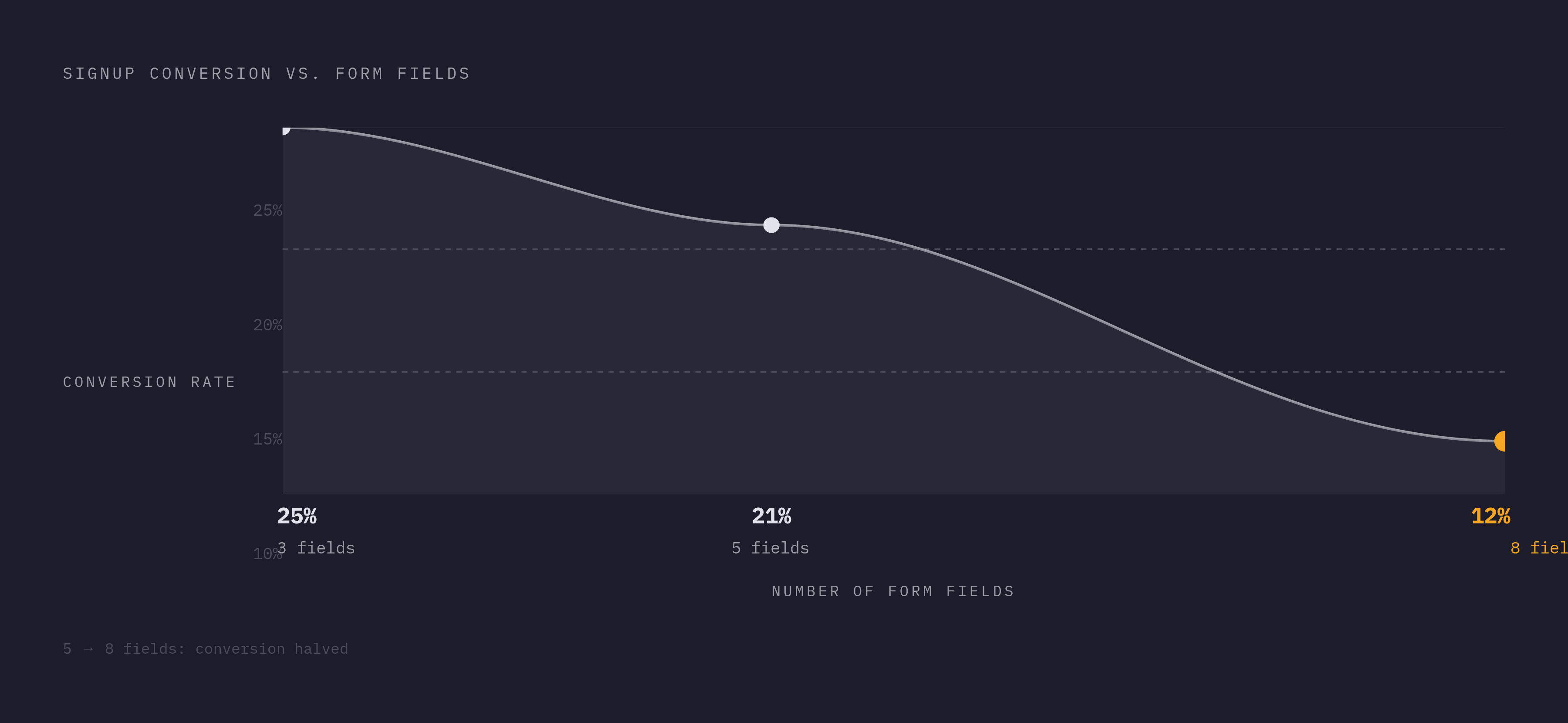
The math on form length is steep, and it isn't linear. Landing page data shows 3-field forms converting around 25%, 5-field forms dropping to about 21%, and 8-field forms falling all the way to roughly 12%. Every field added costs more than the last one, which means the fifth field is far more expensive than the third.
Which means every firmographic field still sitting on a signup form, company size, revenue band, industry, is a field enrichment should be handling instead. Asking for it up front trades away conversion for data a waterfall can usually supply more accurately anyway. That trade almost never makes sense: teams that keep those fields on the form are paying a real conversion cost for something a background process could get for free.
ClickUp's approach is a clean example: collect email only at signup, and push role, team size, and billing information into onboarding after the account already exists. Cutting a form from four fields down to three can lift conversion by close to 50%, which isn't a marginal gain, it's the difference between a form that works and one that quietly bleeds signups.
A useful test for any field still on the form: find out who inside the company actually touches that field's data within 30 days of signup. If the answer is no one, cut it and let enrichment fill it in the background instead.
For the handful of things enrichment genuinely can't know, what someone's actual use case is, which persona they fit, what goal brought them to the product, a short survey inside the product after signup works better than adding another field to the form. It keeps conversion intact while still capturing intent, just on a different timeline.
The fallback stack exists to protect both sides of this at once: data completeness and the experience of the person filling out the form. Built well, it means the form never has to be long in the first place.
Operationalizing the fallback stack: monitoring, re-enrichment loops, and when to prompt users directly
Three numbers, watched continuously, surface a breaking fallback stack before it becomes a full-blown data quality problem. A spike in third-party API call volume usually means a provider is either down or returning empty more often than usual. A dropping cache hit rate means enrichment data is expiring faster than it's getting refreshed. A backlog that keeps growing in the re-enrichment queue means the background worker can't keep pace with new signups coming in.
A circuit breaker pattern handles the reliability side of this automatically. Once error rates from a provider cross a set threshold, calls to it get disabled, cached data or a "pending" state takes over, and calls resume once the provider is healthy again. That one pattern is what stops a single vendor's outage from turning into slow signup pages for every new user.
Re-enrichment can't be a one-time event either. Even a record that was fully accurate the day it was created needs a periodic recheck, regardless of how complete it looked at signup, because contact data doesn't stay put.
There's a point where the system should stop trying quietly and just ask. If a record is still sitting at skeleton status after a full pass through every waterfall provider and a scraping attempt, that's the moment for an in-product prompt, a profile completion nudge, a short onboarding survey, rather than throwing more scraping effort at a company that simply isn't findable. Trying again silently past that point wastes compute on a lookup that already failed twice.
Targeted prompts beat generic ones by a wide margin. Kommunicate focused its in-product messaging on a single specific action, chatbot integration, and lifted signup-to-activation from around 40% up to a 55% to 60% range over seven months. The same logic applies to asking for missing data: a specific, narrow ask beats a generic "complete your profile" banner every time.
One more checkpoint before any of that goes live: consent. Enrichment pulled from a third-party provider and data typed directly by a user carry different obligations under GDPR and CCPA, and prompting someone for information they never explicitly gave needs a compliance review first, not after the prompt is already shipping. The fallback stack needs a compliance layer sitting alongside the data layer, not bolted on once legal asks about it.
A fallback architecture built this way is core infrastructure, not something reserved for when enrichment breaks. It's the actual design, built for a world where enrichment is wrong or missing on a meaningful share of every signup that comes through the door.