Enrichment API Comparison for B2B Onboarding Flows
Choose an enrichment API based on field coverage and latency, not database size alone.

Enrichment API choice for B2B onboarding comes down to four things: field coverage, data freshness, latency, and how the API's delivery model fits your pipeline. Database size, the number most vendors lead with, tells you almost nothing about whether the API will work for your flow. Get this wrong and you won't find out for weeks, once bad matches have already poisoned your scoring model.
Bad fit doesn't show up as a clean failure. It shows up as low match rates on the fields your scoring model needs, latency spikes that developers patch around instead of fixing, or ICP scoring that's wrong from day one because the company data was stale at signup. For onboarding specifically, the damage lands fast: bounced form submissions, leads routed to the wrong rep, a scoring model that's broken before the first cohort of users even finishes signing up.
B2B contact data decays fast, too, somewhere around 2% a month, which adds up to a quarter of your database going stale over a year. An enrichment API that matched well in January can be a real liability by December if nobody refreshes the data underneath it. Most teams don't find this out until it's expensive to fix. They pick a provider based on database size or sticker price, build integrations around that provider's schema, and only a few sprints later discover the gap: no EMEA coverage, no technographic data, a latency spike that blows up their onboarding flow right when it matters most.
Enrichment during onboarding isn't one operation. A form submission gets turned into a full record through CRM enrichment: firmographics, technographics, and contact details layered on for routing and scoring. Lead enrichment appends buying signals, job title, headcount trend, funding stage, so inbound leads get qualified before a human ever looks at them. Identity enrichment checks that the person and company are real and match a canonical record, which matters most in fintech and anywhere AML or KYC rules apply. Founder and investor profile enrichment matters for PLG products where the signer's own track record is part of the qualification signal.
Under those categories sit the actual data types: firmographic (company size, revenue band, industry, funding stage), technographic (what's in the tech stack, which matters a lot if your ICP is defined by a specific tool), contact data (verified email, direct dial, quality here swings wildly by provider), and behavioral or intent signals (job postings, funding announcements, hiring trends), which tend to matter more for sales triggers than for first-touch onboarding. A team onboarding SMB leads off an email domain needs a different API than a team onboarding enterprise accounts off a LinkedIn URL, or a compliance team running KYC checks. Map your input identifiers and required output fields before you look at a single vendor.
The four things that actually determine API fit for an onboarding flow
Field coverage depth beats database headline size, full stop. A database of 700 million profiles means nothing if it doesn't carry the fields your model runs on: direct dials, tech stack, funding stage, whatever those happen to be. Ask whether the API returns data across the dimensions you actually use: firmographic, technographic, contact, behavioral. Coverage on your specific geography and company size band matters more than total record count ever will. Most teams get this backwards. They shop by record count first and check field coverage last, when it should be the reverse, and by the time they notice the gap, the integration is already built around the wrong schema.
Data freshness and update cadence decide whether your scoring model is lying to you. People in the US change jobs on average every 3.9 years, and those moves cluster in certain months, so a 30-day refresh cycle will still miss a chunk of recent changes. Some providers label cached, batch-updated data "real-time" when it isn't. The difference only shows up in match rates on records that changed recently, which means you won't catch it in a demo. For onboarding, this is the criterion that bites hardest: a stale job title or an outdated company size at signup corrupts ICP scoring from the very first touchpoint, and there's no clean way to fix that after the fact.
Latency and delivery architecture aren't a technical footnote, they decide whether the flow works at all. A synchronous flow, enrich on form submit, use the result to route the user in the same session, needs sub-second response times at the median. Some APIs are built for async batch jobs and will stall that flow if forced into it. Worth testing directly: on-demand live enrichment versus a cached database lookup versus a waterfall cascade across several sources. Each has a different latency profile and a different match rate. Webhook delivery suits post-signup enrichment; synchronous REST suits enrichment that happens in-flow, before the user sees the next screen.
Compliance and data sourcing transparency matter more than most teams budget for. GDPR and CCPA exposure differs a lot by provider, and how the data was sourced (scraped from the web, pulled from opt-in networks, licensed from partners, verified by a human) drives a good chunk of that legal risk. Identity enrichment and KYC work carry stricter requirements than standard lead enrichment. Also worth checking: is there a sandbox, clear schema docs, a free tier that lets developers check match rates against their own data before anyone signs anything?
How each major provider maps to those criteria, and which workflow it actually fits
ZoomInfo fits large enterprise onboarding flows where database breadth and intent data justify a bigger spend, and it's a poor fit for almost anyone else. Coverage runs past 260 million professional profiles and 135 million published phone numbers. Pricing starts around $15,000 a year, though real mid-market contracts tend to run higher, and it's annual-contract only. That cost structure, plus API access and intent data sitting behind add-on pricing, rules it out for startups or any self-serve onboarding build.
Apollo.io offers broad contact coverage at low entry cost, useful for outbound-adjacent onboarding enrichment. It claims over 275 million contacts across 73 million companies through what it calls its Living Data Network, and the free tier (100 credits a month) is enough to test match rates before committing further. Check freshness and direct-dial coverage against your own ICP before scaling spend here, since claimed coverage and coverage on your specific segment aren't the same thing.
Clearbit, now folded into HubSpot as Breeze Intelligence, fits teams already living inside the HubSpot stack, especially for anonymous visitor identification and marketing-led growth flows. It pulls firmographic and technographic attributes from over 250 providers, refreshed every 30 days, priced roughly $12,000 to $24,000 a year. That 30-day refresh window is the real tradeoff: recently changed contact data can sit stale for weeks, and the deeper the HubSpot dependency runs, the harder the setup gets to unwind later.
People Data Labs is built for developer teams writing custom enrichment pipelines, internal data products, or AI agents that need raw API access without a UI sitting on top. Coverage runs past 1.5 billion records, self-serve pricing starts at $0.01 a record. A Reddit thread cited by Nubela notes PDL updates on a monthly cycle and its search filters run more basic than some competitors, so check freshness on your specific identifier type before building around it.
Crustdata targets onboarding flows feeding AI agents or LLM pipelines, where stale headcount, funding, or tech stack data corrupts downstream scoring almost immediately. It covers company data across more than 250 firmographic datapoints, headcount trends, funding history, tech stack, web traffic, plus people data across 90-plus datapoints. Its real differentiator is update speed: near-instant refresh against the monthly or quarterly cycles competitors often still call "real-time," with sub-second response times on cached enrichments. That combination matters most for AI-native onboarding products where the enrichment layer has to return current data on every call, not just the lucky one.
Cognism is built around EMEA coverage and GDPR compliance, which makes it a fit for onboarding flows with a heavy share of European traffic and a weak one everywhere else. Its differentiator is phone-verified mobile numbers: phone-verified numbers produce an 87% connect rate against roughly 30% for unverified industry averages. Pricing isn't self-serve, so check your geographic traffic split before starting that conversation, not after.
RocketReach carries the largest raw profile count on this list: over 700 million professional profiles and 60 million companies. But Salesforce integration and API access sit behind the Ultimate plan at $207 per user per month, billed annually, which rules it out as a practical entry point for an API-first onboarding build. Big number, wrong door for most teams reading this.
Cleanlist runs a waterfall model built for onboarding flows where email deliverability matters more than anything else and a single-source match rate isn't good enough. It queries more than 15 premium data sources in sequence: if the first doesn't return a verified email, the cascade keeps going until one does. Claimed fill rates land at 98% for verified emails and 85% for direct dials, priced from $79 a month with a free tier of 30 credits and no card required upfront. The tradeoff is latency: a cascade across 15 sources takes longer than a single lookup, so this fits async post-signup enrichment far better than a synchronous in-flow check.
Proxycurl has been sunset. Its founder is reportedly working on a successor called NinjaPear, per Nubela, but that product is early-stage. Don't plan around Proxycurl as a current option, and treat NinjaPear as something to check back on once it reaches production maturity, not before.
Where web scraping and live crawling fit into enrichment when structured databases fall short
Structured databases, no matter how large, don't cover everything. Brand intelligence, current website content, real-time technographic signals, anything that hasn't been indexed into a vendor's database yet, all of that sits outside the reach of a standard enrichment API. That's where live web scraping and crawling come in: a separate layer, not a replacement for structured enrichment but a complement sitting next to it.
A large and growing share of the modern web runs on JavaScript frameworks like React, Vue, or Next.js, which means a page's real content often doesn't exist until the browser renders it. A plain HTTP fetch grabs an empty shell. Any scraping layer built for enrichment work has to render JavaScript before it extracts anything, which rules out the simplest fetch-and-parse approaches from the start.
Done right, this layer replaces a stack teams otherwise build themselves, including a scraper, a crawler, and a data-cleaning step, all stitched together and maintained as infrastructure nobody wanted to own in the first place. Integration should take minutes, a single working API call, not days of pipeline setup. This matters directly for onboarding flows that need to enrich a prospect's brand identity, homepage copy, or live tech stack straight from the web, rather than pulling from a vendor's cached snapshot that might be weeks old. A number of AI product teams already build on this kind of live-crawl infrastructure as the data layer under their own products.
How to match your onboarding flow's architecture to the right enrichment pattern
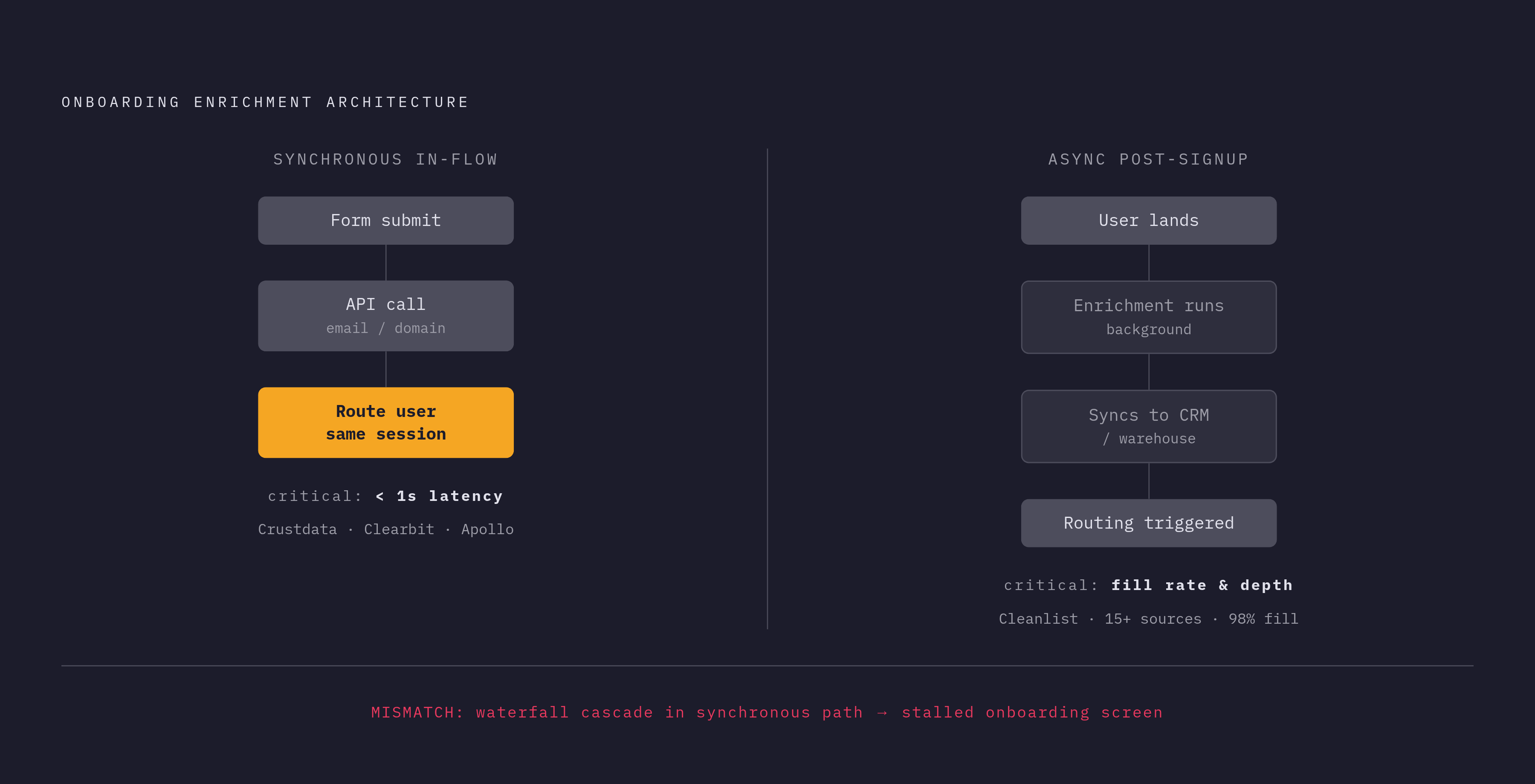
Two onboarding enrichment patterns cover most real builds, and each one demands a different kind of API. Pick the wrong one and no amount of vendor quality fixes it, because the mismatch is architectural.
Synchronous in-flow enrichment happens on form submit: the API call returns, and the result decides how the user gets routed, all inside the same session. This pattern needs sub-second latency at the median and a high match rate on whatever identifier is available at signup, usually just an email or a domain, delivered over synchronous REST. Crustdata's sub-second cached responses, Clearbit/Breeze, and Apollo all fit here, though it's worth testing latency at the tail against your own identifier type before locking in a vendor. Waterfall-cascade providers and async, job-based APIs don't belong in this path. Their whole design is built for a different job.
Async post-signup enrichment works differently. The user lands first, enrichment runs in the background, syncing to a CRM or data warehouse and triggering routing logic afterward. Here, latency matters far less than fill rate and depth, which is exactly where a waterfall provider like Cleanlist earns its cost, cascading across more than a dozen sources to land a verified email even if it takes a few extra seconds to get there.
The pattern that fits your flow decides the API before price or brand name should. A team forcing a waterfall provider into a synchronous path watches onboarding stall while the cascade runs in the background of a screen the user is already staring at. A team routing a low-stakes async job through a premium low-latency API pays for speed nobody downstream is waiting on. Match the architecture first. Shop after.