Progressive Profiling vs. Upfront Enrichment in Product Signup
Combining enrichment and progressive profiling solves what either one misses alone.
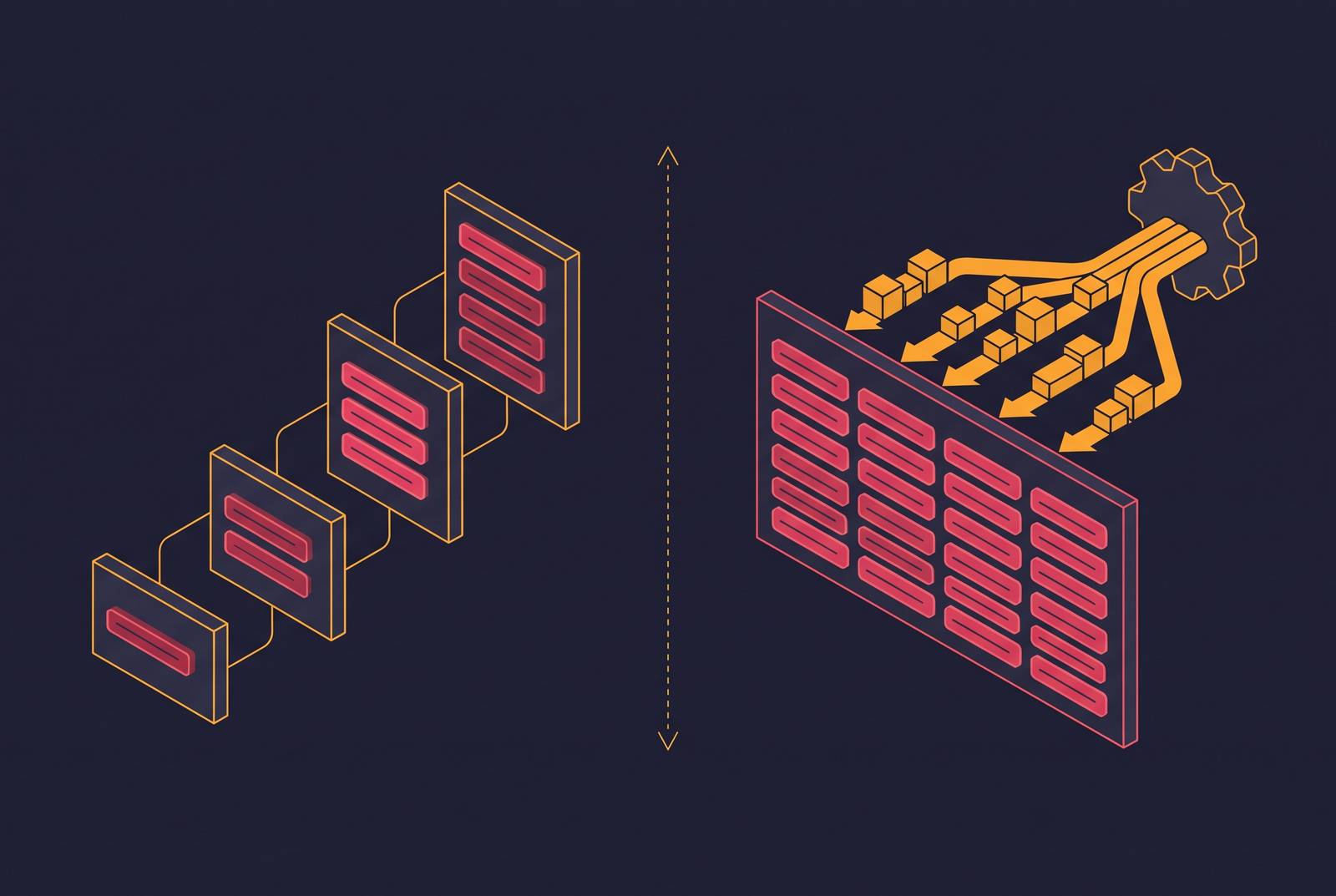
Progressive profiling and upfront enrichment get treated like rival camps in most signup design debates: ask less now, or learn everything up front. That framing misses what's actually happening. The two collect different kinds of data for different reasons, and the best B2B product teams don't pick a side, they split the work.
Enrichment answers who-questions: who is this person, what company do they work for, how big is it, what industry. That's public data, unlike progressive profiling, which answers why-questions and produces data that lives only in the conversation. A domain or an email address is enough to resolve it. Progressive profiling answers why-questions: what is this person trying to do, why now, what does success look like for them. That data lives only in the user's head. No database, however well-funded, can infer intent.
Teams that treat these as competing philosophies end up under-investing in one of them. Picking "ask less" and leaning only on progressive profiling causes firmographic blind spots to pile up in the CRM. Picking "enrich everything" and skipping the conversational asks means the product never learns what the user actually wants, so onboarding stays generic. Both failure modes are common. Both are avoidable. What follows lays out what each approach does well, what it costs to run in production, and how to wire the two together instead of choosing.
What progressive profiling does and where it earns its place in signup
Progressive profiling means collecting user data in small doses over multiple touchpoints, instead of front-loading a signup form with every field the sales team might someday want. Each prompt is small. Each one is timed to something the user is already doing, so it doesn't feel like an interruption.
People who've already gotten something out of a product are far more willing to hand over accurate information than someone staring down a wall of required fields before they've seen any value at all. Data forced out of someone at the point of signup tends to come back sloppy, half-true, or just made up to get through the form faster.
Industry data backs this up with real numbers: approximately 68.32% of people who view a signup form actually start filling it out, and 65.99% finish it. The gap between viewing and starting is the real problem, and it's exactly what progressive profiling is built to close, by making that first ask feel almost weightless.
What progressive profiling is genuinely good at collecting:
- Use case and primary goal (what the person's actually trying to get done)
- Buying stage and urgency
- Feature preferences and how a team actually plans to use the tool
- Pain points, since no public record anywhere lists someone's frustration with their current workflow
The mechanics are mostly conditional logic. Before a field shows up, the system checks whether it already knows the answer. Prompts fire off specific behaviors, like a visit to the pricing page, a key action completed inside the product, or a usage milestone crossed. Auth0's Actions framework is a good example of the pattern in practice: Actions trigger at login and check for missing profile attributes, prompting only for whatever's still blank. It's incremental, session by session, according to Auth0's own documentation and a 2025 write-up from EnH iSecure.
Descope's own product follows a similar shape. Signup asks for name and email, full stop. Everything else, phone number, industry, company name, job title, location, headcount, appears later, after the person has actually used the product or hit a milestone worth asking about.
There's a place where this approach doesn't belong, though. Finance and healthcare products often need full identity verification before a user can do anything at all, and delaying that for the sake of a smoother signup flow isn't a growth optimization, it's a compliance problem. Progressive profiling is a default worth defaulting to, not a rule without exceptions.
And there's a hard ceiling on what it can ever accomplish: it will never recover firmographic facts a user doesn't know off the top of their head or won't bother typing. Company headcount, funding stage, the technology stack IT already runs, annual revenue: these aren't questions most people answer accurately from memory, no matter how well-timed the prompt is.
What upfront enrichment does and the infrastructure it requires to do it in real time
Enrichment at signup isn't the same job as CRM enrichment or list-building for outbound sales. It runs under a much tighter constraint: it has to take an arbitrary email or domain, fill in the missing fields, score the result, and write it back to the CRM, all while the user is still watching a loading spinner on their way to the dashboard.
Done well, enrichment resolves job title, company name, industry, headcount, location, funding stage, technographic signals, and hiring activity, structured facts that already sit in third-party databases somewhere. The catch is that those databases don't stay accurate on their own. B2B contact and firmographic data goes stale at a meaningful clip every year, with decay rates varying widely depending on the source and the field, which means enrichment isn't a one-time integration. It's infrastructure that has to keep running.
The vendor landscape heading into 2026 includes Coresignal, People Data Labs, HubSpot's Breeze Intelligence, Apollo, ZoomInfo, Clay, UpLead, and the Crunchbase API. People Data Labs is backed by more than 1.5 billion person records, with SDKs across Python, Ruby, Go, and Node.
Since December 2023, Clearbit no longer exists as an independent API. HubSpot absorbed it into Breeze Intelligence, which now only works inside the HubSpot ecosystem. Teams running Salesforce, Pipedrive, or something custom-built need to look elsewhere. Breeze Intelligence shortens forms adaptively, hiding fields it can already enrich and showing only the ones it genuinely can't fill in. That's the enrichment-versus-progressive-profiling tradeoff, expressed directly in a form's design.
The real failure mode for enrichment-only strategies is coverage, not accuracy. Mainstream providers cover a solid chunk of the market, but plenty of emerging or long-tail companies return nothing at all, even when the business is completely real and operating. This is why waterfall enrichment has become the standard production pattern: query a fast, developer-first API first, and only fall back to a heavier, larger database when that first call comes up short. It keeps latency and cost down while closing some of the coverage gap.
The data enrichment produces increasingly feeds AI agents and automated scoring systems, not just a CRM field that a sales rep glances at once. The pipeline looks the same on the surface. What consumes its output has changed.
The friction cost of getting the balance wrong in either direction
Asking for too much too soon causes people to leave. Auth0 puts a number on it: 86% of customers say they'll abandon a website outright if the signup form runs too long. That's not a theoretical risk, that's the majority of the funnel walking away before it even starts.
Baseline conversion numbers in B2B SaaS make the stakes clearer. Mailchimp reports average signup conversion somewhere between 2% and 5%. HubSpot's own figures put it between 0.62% and 4.20%, according to Descope's report. At rates that thin, a single percentage point of improvement isn't a rounding error, it compounds into real revenue.
Aggregated industry figures from reform.app (December 2025) make the case for cutting friction:
- Collecting information incrementally drives 42% more form submissions
- 61% more marketing-qualified leads
- Up to 27% more sales-accepted opportunities
- 78% of marketers using progressive profiling say lead quality improved over traditional forms
The effect is real and measurable: reducing required form fields has consistently shown meaningful lifts in submission rates across documented cases. Testimonials helped, sure, but form length did the heavy lifting.
None of this means enrichment is the problem, or that progressive profiling is the fix for everything. Deploying only progressive profiling leaves the sales team working leads with zero firmographic context for weeks. Deploying only enrichment means the product never learns what the user is actually trying to accomplish. Neither approach is broken on its own. The mistake is depending on just one of them.
How the hybrid model divides responsibility between enrichment and progressive profiling at each signup stage
The rule is simple to state, even if it takes real engineering to run: enrichment handles anything an API can resolve, progressive profiling handles everything it can't. No overlap. No asking a user to type in something a domain lookup already answered thirty seconds earlier.
At the moment of signup, enrichment does the work. A real-time lookup fires on the email domain, populating company name, industry, headcount, location, and whatever technographic signals are available. The lead can be scored and routed with real firmographic context, giving sales or success teams meaningful signal before their first outreach. Everything writes back to the CRM, and any record enrichment couldn't fill gets flagged for a progressive prompt down the line.
At first login and through the early product sessions, progressive profiling takes over. It only asks what enrichment left blank, and only what actually changes how onboarding should go. Conditional logic keeps it clean: if enrichment already returned a job title, nobody asks for it again. Good first-session questions include the primary use case, the size of the team actually using the tool (a different number than total company headcount), and whatever immediate goal brought the person in the door.
Behavioral triggers keep the conversation going after that:
- A pricing page visit can prompt a question about where the user is in their evaluation
- Activating a key feature can prompt a question about the goal they're working toward
- Hitting a usage milestone can prompt a question about how they plan to use the product going forward
The waterfall logic that governs enrichment APIs applies here too. If the first enrichment source comes back blank, the pipeline should try a second source before ever surfacing a form field to the user. Asking someone to manually fill in something a fallback API might still resolve is wasted friction.
And because B2B data goes stale over time, re-enrichment can't stop after signup. The hybrid model covers onboarding, but the enrichment layer needs to keep running on a recurring basis, because it sits underneath that model and sustains it.
Building the enrichment pipeline with live web data when third-party APIs leave gaps
When a third-party database comes back empty, the company's own website is often the fastest way to fill the gap. Crawling the team page, the about page, and current job listings pulls out industry, size signals, product descriptions, and contact structure straight from the source, no vendor middleman required.
Live web data surfaces things a static database usually misses:
- Current product positioning, which is almost always more accurate than a database entry that hasn't been touched in months
- Hiring signals that hint at growth stage and which functions the company is prioritizing right now
- Technology stack clues buried in job descriptions and in a site's own footer scripts
- Brand and visual identity details for product experiences that need to pull them in programmatically
The typical pipeline for this runs in two stages. The first stage pulls raw HTML or content off the target domain. The second stage hands that content to a language model with a strict JSON schema attached, so the output comes back as a structured record: company name, description, industry, product details, all typed and predictable rather than free text.
Defining that schema before writing a single line of extraction code matters more than it sounds like it should. Locking down fields like company name, industry, a headcount signal, product description, and key personnel with something like Pydantic or JSON Schema keeps the output honest. Retry logic that automatically resubmits a request when a field comes back null or missing closes most of the remaining gaps.
Scrapers built this way also need to survive a website redesign without falling over. Researchers at McGill found that a machine-learning-based extraction approach held 98.4% accuracy even after page structures changed, and cut setup time from weeks down to hours. That matters a lot for any enrichment pipeline leaning on live scraping, since company websites redesign constantly and a brittle, selector-based scraper breaks every time one of them does.
There's a cost tradeoff to plan around from day one. Running everything through an LLM adds latency and adds a real dollar cost per call. Selector-based extraction is the better fit for stable, high-volume fields that rarely change shape. LLM-based extraction earns its cost when meaning matters more than the exact markup, and a production pipeline usually ends up running both, split by field.
Every model has a token ceiling, and if a prompt plus an HTML chunk runs past it, the output truncates without any warning. A production pipeline needs a chunking strategy and a validation step built in from the start. A prompt and a hope is not a pipeline.
Keeping enriched profiles current after signup, and why static data is the same problem as a stale RAG index
Static enrichment data and a stale RAG index fail for the exact same reason: both quietly stop being trustworthy the moment nobody refreshes them against the live web. A profile enriched perfectly on day one is already drifting toward inaccurate by day ninety, at a pace that makes an occasional manual data cleanup nowhere near enough. The enrichment layer has to run continuously, not as a task that gets marked done after signup.
That drift matters even more once AI agents start acting on the data. Gartner projected in 2025 that 40% of enterprise apps would carry task-specific AI agents by the end of 2026, up from under 5% before. An agent making decisions off a firmographic record that's six months stale is making decisions on bad information, and it won't necessarily flag that the information is bad.
Live web enrichment handles this differently than a scheduled database refresh does. Crawling a company's actual website in real time picks up a pivot, a new product line, or a round of layoffs well before a third-party database gets around to updating its own records, which can take weeks or months depending on the vendor.
That's where the idea of a freshness TTL comes in: a per-record or per-domain decision about when cached data is trustworthy enough to reuse, and when it needs a fresh fetch. A fast-moving AI startup probably needs a much shorter TTL than a hundred-year-old manufacturing firm that hasn't changed its org chart in a decade.
Progressive profiling, in this frame, doubles as a freshness signal in its own right. A behavioral trigger, like someone visiting the enterprise pricing page six months after they first signed up, doesn't just prompt a new question. It's a sign that the person's situation has shifted since the day their profile was first enriched, and that the record on file might already be out of date.